Thirteen months to a chip off the moon
China’s Tianwen-2 mission to curious asteroid Kamo‘oalewa is underway. Also, how to read newsprint from 1.3km, and new climate insights from the mysterious Inca Khipu records.
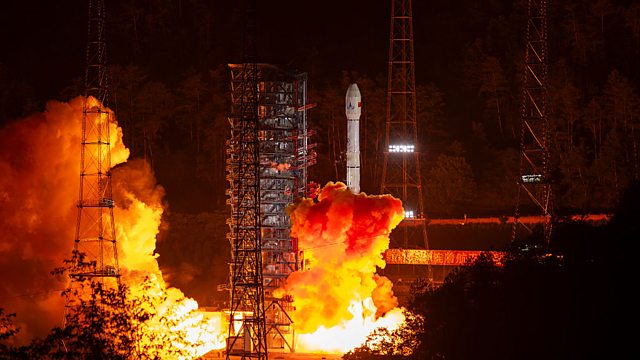
China is aiming to join the small club of nations who have successfully returned scientific samples of asteroids for analysis on earth, teaching us more about how our and potentially other solar systems formed. Tianwen-2 launched successfully this week, bound for an asteroid known as Kamo‘oalewa, which sits in a very strange orbit of both the earth and the sun, making it a “quasi-satellite”.
Last year, scientists including Patrick Michel of the Côte d'Azur Observatory in France, published an intriguing suggestion that Kamo‘oalewa might in fact not be a conventional asteroid, but instead be a small piece of our moon that was ejected when the Giordano Bruno crater formed. In a little over a year from now, we might find out if that is right.
Do you have to hold text at arm’s length to read properly? Qiang Zhang, professor of physics at the University of Science and Technology of China, whose team recently published their demonstration of using a technique from radio astronomy but using optical light. Active Optical Interferometry involves using laser beams to achieve resolutions at distances far in excess of conventional imaging with lenses. As his team showed, and as Miles Paggett of Glasgow University admires, they managed to read newsprint sized letters at a distance of over 1.3km.
Finally, how did the Inca Empire write things down, and who did the writing? It has been thought that ornate threads of strings and baubles known as khipu are how records were made for business and administration, probably by a decimal code of knots in strings. But the exact purpose, nature and any meaning encoded therein, has eluded scholars for decades. Sabine Hyland, an anthropologist at the University of St Andrews, Scotland, has been studying them for years, and recently was granted access to the records of a village, only the fourth known, to have continued a form of the khipu tradition after the Spanish conquest to this day. She believes that they could even provide us in the modern world with valuable climate data.
Presenter: Roland Pease
Producer: Alex Mansfield
Production co-ordinator: Jazz George
(A Long March-3B Y110 carrier rocket carrying China's Tianwen-2 probe blasts off from the Xichang Satellite Launch Center on 29 May, 2025 in Sichuan Province of China. Credit: VCG/Getty Images)
Last on

More episodes
Featured
.
Broadcasts
- Thu 29 May 202519:32GMTBBC World Service
- Thu 29 May 202522:32GMTBBC World Service Europe and the Middle East
- Fri 30 May 202504:32GMTBBC World Service Australasia, Americas and the Caribbean, South Asia & East Asia only
- Fri 30 May 202508:32GMTBBC World Service
- Fri 30 May 202512:32GMTBBC World Service
 Sat 31 May 202501:32GMTLive News
- Sat 31 May 202501:32GMTBBC World Service News Internet & East Asia only
- Sun 1 Jun 202523:32GMTBBC World Service except East Asia, Europe and the Middle East, News Internet & South Asia
- Mon 2 Jun 202500:32GMTBBC World Service Europe and the Middle East
Podcast
![]()
Science In Action
The BBC brings you all the week's science news.

Related Content
