Why don't more animals have opposable thumbs?
Thumbs are incredibly useful to humans, giving us great dexterity and tool-handling skills. Why didn’t this handy trait evolve in more species?
On a recent kayaking trip, CrowdScience listener Lanier sliced through his right thumb, putting it out of action for a while. This made life difficult, as he couldn’t button his shirt, tie his shoelaces or type efficiently on his smartphone. Missing the use of his thumb made him wonder: since opposable thumbs are so advantageous to those of us who have them, why didn’t they evolve in more species?
Host Marnie Chesterton unpicks the evolution of our own unique thumbs with the help of paleoanthropologist Tracy Kivell, learning how our grip compares to that of other animals. We discover why mammals like horses and dogs have no use for thumbs, and why we humans don’t have opposable big toes.
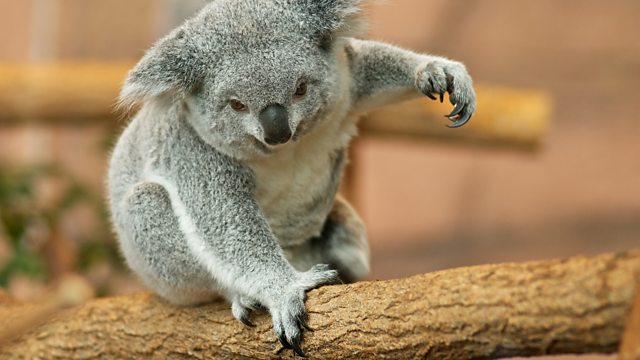
Meanwhile, at Taronga Zoo in Sydney, Australia, senior keepers Tarryn Williams Clow and Bec Russell-Cook introduce us to two different marsupials. Humphrey the koala has not one but two thumbs on each hand. Why did koalas develop this anatomical quirk when their closest living relative, the wombat, has spade-like digits? Dr Mark Eldridge from the Australian Museum shares his hypothesis.
And what if we, too, had another thumb? Marnie tries on a robotic Third Thumb, built by designer Dani Clode. Dani has collaborated with neuroscientists from the Plasticity Lab at the University of Cambridge. She tells us what the Third Thumb has revealed about the human brain and how we control our digits.
Presented by Marnie Chesterton
Produced by Cathy Edwards and Margaret Sessa Hawkins for the BBC World Service
(Photo: Kung-Fu Koala - stock photo Credit: Alex BOISSY / Getty Images)
Last on
More episodes
Featured
.
Broadcasts
- Fri 20 Feb 202620:32GMTBBC World Service Online, Americas and the Caribbean, UK DAB/Freeview & Europe and the Middle East only
- Fri 20 Feb 202621:32GMTBBC World Service except Online, Americas and the Caribbean, Europe and the Middle East & UK DAB/Freeview
- Mon 23 Feb 202602:32GMTBBC World Service except Americas and the Caribbean
- Mon 23 Feb 202605:32GMTBBC World Service Australasia, Americas and the Caribbean, South Asia & East Asia only
- Mon 23 Feb 202609:32GMTBBC World Service
- Mon 23 Feb 202613:32GMTBBC World Service Australasia, East and Southern Africa, News Internet & West and Central Africa only
Podcast
![]()
CrowdScience
Answering your questions about life, Earth and the universe

Related Content
