Big Tech's big legal headache
The Supreme Court considers whether big tech should be liable for the extreme content others post on their platforms. And how Ukraine's huge sector has coped with a year of war.
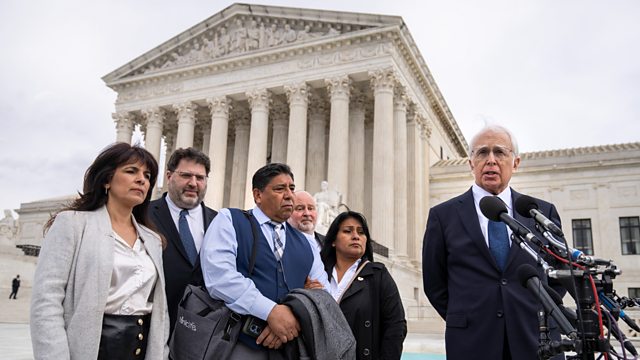
The US Supreme Court is hearing claims that big tech firms such as Google and Twitter should be considered the publishers of the harmful content that appears on their platforms. Dr. Mary Anne Franks, president of the Cyber Civil Rights Initiative, tells us how it could change the way the internet works everywhere in the world.
A year on from the Russian invasion of Ukraine we speak to one of the country's thousands of tech workers about how she has adapted to living and working in a time of war - and the government tells us the tech sector has kept growing, despite the destruction and loss of life.
We find out about how some internet users in South Africa have had to become night owls because of the soaring cost of mobile data. And how users can ride a virtual reality jet-ski - just by thinking about it.
(Photo: Attorney Eric Schnapper speaks to the press outside the US Supreme Court following oral arguments in Gonzalez v Google, a landmark case about whether technology companies should be liable for harmful content their algorithms promote, 21 February, 2023. Credit: Drew Angerer/Getty Images)
Last on
Broadcasts
- Fri 24 Feb 202309:32GMTBBC World Service
- Fri 24 Feb 202320:06GMTBBC World Service Americas and the Caribbean, UK DAB/Freeview, Online & Europe and the Middle East only
- Fri 24 Feb 202321:06GMTBBC World Service except Online, Americas and the Caribbean, Europe and the Middle East & UK DAB/Freeview
- Sun 26 Feb 202323:06GMTBBC World Service except East and Southern Africa & West and Central Africa
- Mon 27 Feb 202303:06GMTBBC World Service
Get in touch with Tech Life

Email us at techlife@bbc.co.uk or contact us via WhatsApp on +443301230320
Podcast
![]()
Tech Life
How tech is transforming the way the world works, learns and plays