The first galaxies at the universe's dawn
James Webb Space Telescope pushes our view of the universe ever deeper back in time. Also the earliest known predatory animal, prehistoric kissing and the cold sore virus.
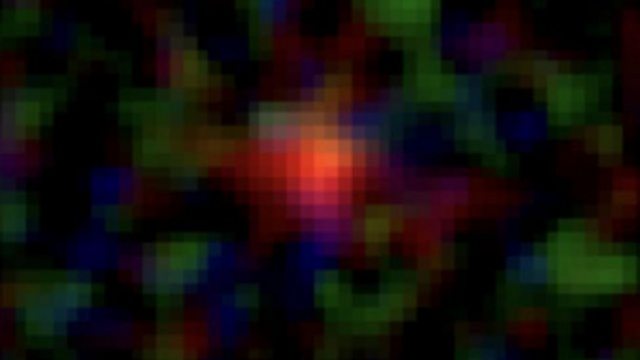
In the last week, teams of astronomers have rushed to report ever deeper views of the universe thanks to the James Webb Space Telescope. These are galaxies of stars more than 13.5 billion light years from us and we see them as they were when the universe was in its infancy, less than 300 million years after the Big Bang. As University of Texas astronomer Steve Finkelstein tell us, there are some real surprises in these glimpses of the cosmic dawn. The super-distant galaxy that Steve's group has identified is named after his daughter Maisie.
Also in the programme: a 550 million year old fossil which is much the oldest representative of a large group of animals still with us today. The early jellyfish relative lived at a time known as the Ediacaran period when all other known complex organisms were weird, alien-looking lifeforms with no surviving descendants. Roland Pease talks palaeontologist Frankie Dunn at the University of Oxford who's led the study of Auroralumina attenboroughii.
Did the cultural invention of romantic kissing five thousand years ago lead to the spread of today's dominant strain of the cold sore virus (Herpes simplex 1) across Europe and Asia? That's the hypothesis of a team of virologists and ancient DNA experts who've been studying viral DNA remnants extracted from four very old teeth. Cambridge University's Charlotte Houldcroft explains the reasoning.
Image: Maisie's Galaxy aka CEERSJ141946.35-525632.8.
Credit: CEERS Collaboration
Presenter: Roland Pease
Producer: Andrew Luck-Baker
Last on

Broadcasts
- Thu 28 Jul 202219:32GMTBBC World Service except East and Southern Africa & West and Central Africa
- Fri 29 Jul 202203:32GMTBBC World Service Australasia, South Asia & East Asia only
- Fri 29 Jul 202204:32GMTBBC World Service Americas and the Caribbean
- Fri 29 Jul 202208:32GMTBBC World Service
- Fri 29 Jul 202212:32GMTBBC World Service Australasia, Online, UK DAB/Freeview, News Internet & Europe and the Middle East only
- Fri 29 Jul 202219:32GMTBBC World Service East and Southern Africa & West and Central Africa only
- Sun 31 Jul 202201:32GMTBBC World Service Americas and the Caribbean & News Internet only
Podcast
![]()
Science In Action
The BBC brings you all the week's science news.