More yield, less field
Could a farming technique called Pfumvudza be Zimbabwe's answer to food security in the face of climate change?
This year Zimbabwe has had a bumper crop of the staple food, maize. It is only the second time in two decades that it has grown enough food for the whole population. Last year they barely had half of what was needed and 7.7 million people went hungry.
Better rainfall is largely to thank, but a new farming technique, called Pfumvudza is also being celebrated as having a dramatic impact on the amount Zimbabwe’s smallholder farmers have produced, increasing their yields up to four times. Advocates say it holds the key to food security and makes farmers more resilient to the realities of climate change - hotter, drier, stormier weather, which makes farming even harder.
Dr Matthew Mbanga is CEO of the organisation which designed Pfumvudza. He explains the “more yield, less field” principle, which encourages farmers to more intensively cultivate a smaller area of land. They dig basins instead of ploughing rows and produce their own organic fertiliser. Dr Mbanga argues that Pfumvudza must be a central part of Zimbabwe’s climate change response because it helps farms cope better in the hotter, drier, stormier weather.
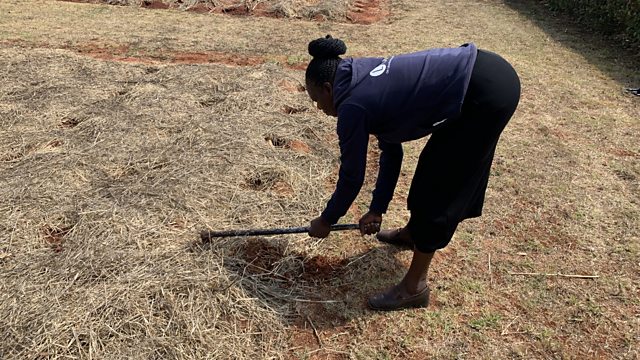
Image: Consilia Chianako, a trainer at Foundations for Farming, demonstrates how to dig holes into 'mulch' cover (Credit: Charlotte Ashton)
Last on

More episodes
Previous
Broadcasts
- Tue 9 Nov 202102:32GMTBBC World Service
- Tue 9 Nov 202109:06GMTBBC World Service
- Tue 9 Nov 202113:32GMTBBC World Service East and Southern Africa, South Asia, West and Central Africa & East Asia only
- Tue 9 Nov 202120:06GMTBBC World Service Americas and the Caribbean, UK DAB/Freeview, Europe and the Middle East & Online only
- Tue 9 Nov 202121:06GMTBBC World Service except Online, Americas and the Caribbean, Europe and the Middle East & UK DAB/Freeview
- Sun 14 Nov 202105:32GMTBBC World Service except East Asia & South Asia
Featured in...
![]()
Climate change: How it is affecting lives and the fight for change—BBC World Service special collections
The effects of climate change are destroying lives, environments and livelihoods