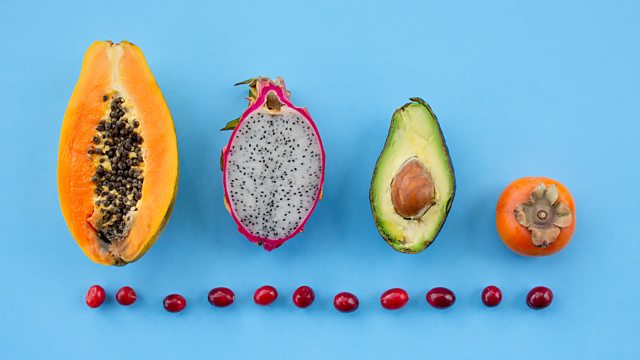
Why are seeds such different sizes?
While eating a blackberry one day, CrowdScience listener Charles got one of its tiny seeds stuck in his teeth. That started him wondering: why are seeds the size they are?
When eating a blackberry one day, CrowdScience listener Charles got a tiny seed stuck in his teeth. That got him wondering: why are seeds the size they are? Why does a blackberry have dozens of tiny pips, while a peach has one huge stone right in the middle?
Plant seeds have been around for hundreds of millions of years, so they’ve had plenty of time to shapeshift into wildly different forms: from dust-like orchid seeds to giant coconuts. This evolution has been a long and intricate dance with wind, water and animals; we ask how different kinds of seeds might respond to today’s environmental threats and rapidly changing ecosystems.
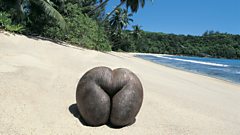
And we go in search of the world’s biggest seed, the coco de mer: native to just two remote islands in the Indian Ocean and weighing up to 18kg, how did this seed evolve to be so much bigger than any other?
With Professor Angela Moles, Dr Si-Chong Chen, Marc Jean-Baptiste, Dr Frauke Fleischer-Dogley and Dr Wolfgang Stuppy.
Presented by Marnie Chesterton
Produced by Cathy Edwards for the BBC World Service
[Photo: Different sized fruit seeds. Credit: Getty Images]
Last on
Clip
![]()
How the world’s biggest seed got so huge
Duration: 01:39
Broadcasts
- Fri 30 Apr 202119:32GMTBBC World Service
- Sat 1 May 202101:32GMTBBC World Service East Asia
- Mon 3 May 202104:32GMTBBC World Service Australasia, Americas and the Caribbean, South Asia & East Asia only
- Mon 3 May 202108:32GMTBBC World Service
- Mon 3 May 202112:32GMTBBC World Service except East and Southern Africa, East Asia, South Asia & West and Central Africa
Podcast
![]()
CrowdScience
Answering your questions about life, Earth and the universe