Harvard Law School’s first Deafblind graduate
When Haben Girma was at Harvard she developed a new piece of technology that helps her communicate. She even got the attention of the White House.
Haben Girma is a Harvard Law School graduate, an attorney, she's been invited to the White House... and she's Deafblind. Haben has published a book called Haben: The Deafblind Woman Who Conquered Harvard Law.
Tresor Riziki's path to superstardom in South Africa started with a journey across half of the African continent. But he’s not from South Africa, and he had a pretty tough journey getting there. Tresor started life in Goma, in the Eastern DRC, a small city that has experienced decades of armed conflict and volcanic eruptions, and he knew he'd have to leave to pursue his music.
Get in touch: outlook@bbc.com
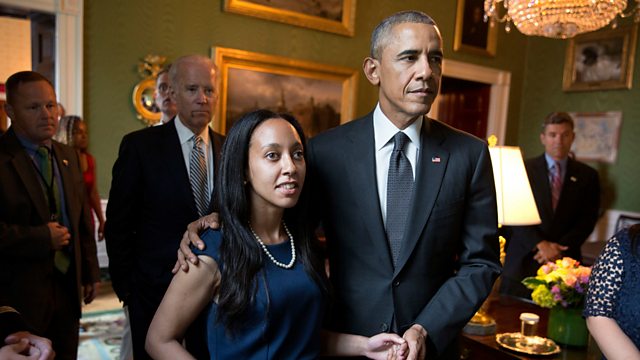
(Photo: Haben Girma meeting Barack Obama in 2015. Credit: White House/ Pete Souza)
Last on
Outlook transcript
THE ATTACHED TRANSCRIPT WAS TYPED FROM A RECORDING AND NOT COPIED FROM AN ORIGINAL SCRIPT. BECAUSE OF THE RISK OF MISHEARING AND THE DIFFICULTY IN SOME CASES OF IDENTIFYING INDIVIDUAL SPEAKERS, THE BBC CANNOT VOUCH FOR ITS COMPLETE ACCURACY.
Outlook: Harvard Law School’s first Deafblind graduate
Original TX: 12.12.19
PRESENTER: Emily Webb
GUEST: Haben Girma
Emily Webb
How was your journey in?
Haben Girma
you know. It wasn't that bad this morning. We did hit rush hour yesterday.
Emily Webb
Yeah.
Haben Girma
And we waited at the platform for three trains and still couldn't get in. So then we went to the opposite platform… (fades out)
Emily Webb
But in other respects, the way that she experiences the city is very different. Harben's Deafblind so as she walks through the busy London streets she struggles to hear and see her surroundings. She did have limited hearing in high frequencies as a child and trained herself to speak in a higher pitched voice, but her sight and hearing have since deteriorated. When Harben came in she had her guide dog, Milo, and a specially adapted Braille computer.
Haben Girma
I have the Braille computer in front of me and dots pop up on the display. I run my fingers over the dots and feel the letters. It's wirelessly connect it to a keyboard, a standard QUERTY keyboard and a typist types on the keyboard and it immediately appears in Braille. So as you're speaking, Emily, the words are going to appear in Braille. I'm running my fingers over the dots reading it myself and then responding with my own voice.
Emily Webb
So you have Gordon, your typist here – you're both sitting opposite me at the moment. When you go into a new situation will you also get Gordon to describe their surroundings? What sort of things do you want to know about the situation you're going into?
Haben Girma
It's sometimes Gordon, sometimes someone else. And I do ask them to describe visual and audio information.
Emily Webb
Did you get a description of the room we're in right now?
Haben Girma
Not yet. Would you like to describe it. Emily?
Emily Webb
No, I mean err, it's really not very exciting, so I feel like my description won't be something you want to hear. We're in a very… What are we in? We're in a slightly unappealing green looking radio studio. Um. There's soundproofing all over the walls and we've got a big table in the middle where we've got a lot of microphones around and I'm sitting opposite you and obviously you have Gordon to your left hand side.
Haben Girma
Emily, this is probably a room you spend a lot of time in. Any personal touches here?
Emily Webb
Literally none whatsoever. So we will basically switch between different radio shows, so the minute we're out the next one will come in. So unfortunately no personal touches. There was once a mouse in here. But that's about as personal an anecdote as I have about this studio. (Both laughing).
Haben Girma
I am sure each room has its own secrets including seeing little animals
Emily Webb
So let's focus more on you. So tell me, whereabouts did you grow up?
Haben Girma
I was born and raised in California. My parents are from Eritrea and Ethiopia and North East Africa and the net in the Bay area.
Emily Webb
What did they tell you about their lives back in Eritrea and back in Ethiopia.
Haben Girma
My parents grew up telling me the stories of the war where. So there was a war for thirty years between Eritrea and Ethiopia. And my mother, she unfortunately experienced a lot of violence during that time.
Emily Webb
Haben's mother left. Eritrea at sixteen and travelled by foot into neighbouring Sudan. From there she ended up in the US as a refugee. That's where she met Haben's dad. He's from Ethiopia was studying in California. How would you describe their personalities. I mean, what they like to grow up with?
Haben Girma
My parents had high expectations for me and they wanted me to do everything non disabled kids do, so they would say you know you have to do chores just like your other siblings and I would tell them, "I'm blind. I can't do dishes" and they would say, "Oh, yes. You can. Go do the dishes."
Emily Webb
And when was it though that they first realised that you were having issues with your vision and with your hearing?
Haben Girma
I have an older brother who's six years older and he is also deaf blind. So when they realised he is deaf blind they started having me go see doctors, take the Senate hearing test and that's when they identified that, yes, I also have same loss.
Emily Webb
And how old were you when they started to realise that?
Haben Girma
I was about age five. When I was little, I had some vision, so it was hard for them to tell, "Is she just ignoring me or does she not see that I'm them waving her over?"
Emily Webb
So, as a child, you were obviously growing up in the US, but would you ever go to visit your family in Eritrea?
Haben Girma
Every three years or so we would go back to Asmara and Addis Ababa – the capital cities of Eritrea and Ethiopia. I have lots of family there. So we would spend summers with familes, play with the kids in the neighbourhood, cause all sorts of trouble!
Emily Webb
And did you notice a difference in your experience growing up in the US and then visiting Eritrea and Ethiopia? I mean would it be more difficult when you are out of the country, out of the US?
Haben Girma
I wouldn’t necessarily say it was more difficult. I was identified as an American when I was in Eritrea and Ethiopia, which comes with a lot of admiration and questions and suspicions, so it was it was a complex identity to navigate. Then when I came back to the United States I was just the disabled girl. So it was interesting navigating standing out for being disabled and standing out for being an American.
Emily Webb
You mentioned that you had this older brother who is also Deafblind. He was living in Eritrea. How. different were your experiences?
Haben Girma
Our experiences were completely different. My family took him to the school for the blind and the school for the blind in Eritrea told them "He's deaf, we can't teach him". Then they tried taking him to the school for the deaf in Eritrea and they told them, "He's blind, we can't teach him". So for his first twelve years he could not go to school. Whereas in the United States, where I was born and raised I had immediate access to school since kindergarten and they were able to provide Braille training, sign language training, assistant computers, how to use a web-cam. Starting in the fourth grade, they would take us skiing, kayaking, river rafting. It never occurred to me to wonder, "Can a blind person ski?" cos I've been doing it since I was eight years old.
Emily Webb
When you would go to school were you the only deaf blind child there?
Haben Girma
I think for most of the time I was the only deaf, blind student, and only blind student in my specific grade. It was really hard for me to meet friends because kids did not know how to communicate with me. So if they would wave at me from across the playground and I wouldn't respond they would think. "Oh, she's rude, she doesn't like me" and that made things really frustrating. People would assume that I was rude and mean, when in fact I couldn't see them waving, or couldn't hear them calling my name.
Emily Webb
Did you enjoy school? I mean it sounds like you were quite academic. Did you really enjoy learning?
Haben Girma
I love reading, I love learning, but I did not like school. You feel isolated and excluded and left out.
Emily Webb
So when you would go home at the end of the day and say you had had a really difficult day at school. What would your parents say to you? I mean, how would they comfort you in that situation?
Haben Girma
LAUGHS My parents felt that it was a privilege, an honour to be having an education, so don't complain!
Emily Webb
So no sympathy…
Haben Girma
Just be grateful….They wanted me to work hard and excel in school. So I did my best to work hard and excel in school. They did not know Braille. They did not fully understand all the struggles and challenges I had.
Emily Webb
You said that you enjoyed reading. What were some of your favourite books growing up?
Haben Girma
I was a huge fan of the Nancy Drew Books
Emily Webb
So the detective novels…
Haben Girma
… the detective novels because in my own life I felt like I had to be a detective. I could not see what was written on the board so I had to look around for clues to figure out if there was homework assigned or not. I had to investigate, hunt down the instructor and ask them what was the homework, is there homework tonight?
Emily Webb
Do you think that was your happy place, was that where you found solace in reading?
Haben Girma
Yes, yes. I loved reading. Reading was fully accessible to me. I have complete access to all the words. Whereas television, films, I don't know what's happening on screen. Books have been so important in my life.
Emily Webb
And when you would read books as a child, even though your sight wasn't that good, would you have really strong mental pictures inside your mind.?
Haben Girma
Gosh. I would say not visual pictures. I experience the world in my dreams and mind similar to the way I experience the world in the waking world. A lot of people ask what are your dreams like. And that's my answer. There's also the sense of knowing intuition. That's hard to describe but exists. So in dreams and in stories I know things. Don't necessarily know how I know them, but it just feels intuitive.
Emily Webb
Haben's love of learning got her a place at university in Oregon. But persuading her parents to let her go away was a whole different matter.
Haben Girma
LAUGHS My parents wanted me to stay home, they wanted me to live at home and go to a local college. And I said no, I knew that if I stayed home I would never learn independent skills. They would insist on doing my laundry and cooking for me, and all those things. I wanted to be self-reliant . So I deliberately chose a school that was far from home, that would force me to develop my independent skills.
Emily Webb
How did you convince them?
Haben Girma
I am very stubborn. So I kept saying : I'm going to be able to do this. I can do this. Here's how I will do it .
Emily Webb
When Haben arrived at University there was some basic challenges. Her hearing and vision had got progressively worse. She wasn't using her Braille computer yet. And as the canteen menu wasn't in Braille she never knew what food was available. This only changed when Haben realised that this was against the law because it discriminated against disabled people, which sparked an idea. Haben decided that she wanted to become a lawyer to help bring around more changes for people with disabilities. She then won a place at one of the most prestigious institutions in the world, Harvard Law School
Haben Girma
When I arrived Harvard told me they never had a Deafblind student before her and I told them I'd never been to Harvard Law School before.
Emily Webb
What did that feel like to be the first person? Did it feel overwhelming at all?
Haben Girma
It felt overwhelming because the burden would fall on me to come up with solutions to pioneer my way through the unknown. That gets incredibly exhausting, but it was also thrilling. It's an adventure. I am creating more opportunities for the students who come after me.
Emily Webb
And it was when you were at Harvard that you did come up with this system for communicating where you used the keypad, how did that come about?
Haben Girma
Yes, in 2010. The company that creates this Braille computer released a version with Bluetooth and that triggered the idea that maybe I could connect to the Braille computer with an external wireless keyboard. Now Harvard Law School's a place that's stereotyped as full of snobbish, arrogant people and I was concerned that they will not want to connect with me or do something different, but I did find students who were happy to type. Typing was familiar to a lot of people, especially millennials.
Emily Webb
So obviously the way it works is that you'd ask a student to type into this keypad and then, the Braille would come up and you'd be able to read it. Would you take it everywhere with you? I mean would you take it to say a bar in Harvard or something like that ?
Haben Girma
LAUGHS So for most of my life, I would avoid a loud, noisy places because I couldn't hear what was going on, and people wouldn't be able to hear me. But bars are places where law students have gathered since millennia. So I said you know what, I need to figure out how to do bars. And one day I took the Braille computer and keyboard to a bar and I told people, please, type what you're saying and then I'll be able to read the Braille and they actually did. They started typing their conversation and typing descriptions of the room. It was fantastic. They also discovered that because bars are so loud it was easier for them to type rather than to try to shout so they would come over to chat with me. So they can take a break from shouting in the very large room!
Emily Webb
Did you find that as the evening progressed, the typing became less coherent?
Haben Girma
LAUGHS Some people have had a little too much to drink become difficult to understand.
Not just in their speech, but also in their typing and one student he was typing complete gibberish at the end of the evening. I had to help walk him home.
Emily Webb
After her graduation Haben became an attorney and did what she set out to do. She won a ground breaking case to help blind readers gain access to books on-line although she now works trying to help organisations become more accessible. As part of that she's invited to give talks all over the world.
And you have had some other very high profile invitations, including an invitation when Barack Obama was president to the White House and I hear that when you went to meet him you found out that he wasn't a particularly good typist.
Haben Girma
LAUGHS He was a good typist, but a slow typist. And he had a wonderful sense of humour. He was able to laugh about that, and at that point I wanted to reassure him and said, Oh, you're doing great, my dad types with two fingers. And he says "I do too". BOTH LAUGH I didn't know he was typing with two fingers, but he was laughing. Everyone was laughing.
Emily Webb
And how did it feel to be at the White House on that day and to meet him?
Haben Girma
We were at the White House to celebrate the twenty fifth anniversary of the Americans With Disabilities Act, so disability advocates from all over the country got together. And I had the honour of introducing President Obama and vice president Joe Biden at the event.
Emily Webb
What do your family back in Eritrea make of what you've achieved?
Haben Girma
They're all amazed and it's such a huge difference compared to being told "No, my brother cannot go to school" to all of a sudden having a sibling that went to Harvard Law School.
Emily Webb
What about your parents. Do you think they're glad they let you have that bit of independence?
Haben Girma
LAUGHS My parents love me and are very proud of me. They do wish that I didn't travel so much, they would prefer to have me home right now rather than having me in the UK
Emily Webb
Is there anything that they have managed to stopped you from doing?
Haben Girma
LAUGHS No, they have not managed to stop me from anything.
Broadcasts
- Wed 17 Nov 202112:06GMTBBC World Service
- Wed 17 Nov 202118:06GMTBBC World Service except East and Southern Africa & West and Central Africa
- Wed 17 Nov 202123:06GMTBBC World Service East and Southern Africa & West and Central Africa only
- Thu 18 Nov 202103:06GMTBBC World Service
Watch Lives Less Ordinary on YouTube
Videos from our extraordinary podcast Lives Less Ordinary.
Contact Outlook
Info on how we might use your contribution on air
Podcast: Lives Less Ordinary
Step into someone else’s life and expect the unexpected
