From the Crimean War to the end of World War Two
Andrea Sella looks at the role chemists have played in the development of chemical weapons.
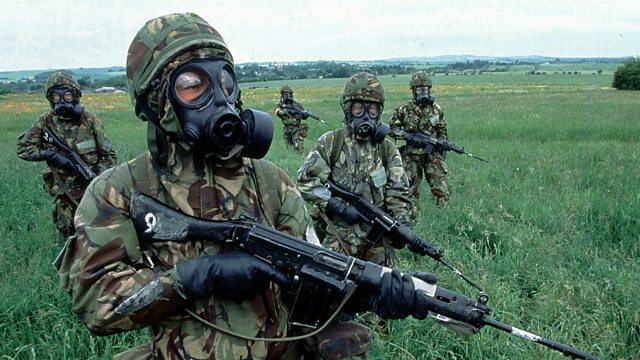
In the first of two programmes he looks back to the first attempts to ban the use of chemical weapons at the end of the 19th century. Heavily defeated in the Crimea, Russia succeeded in getting unanimous agreement at the 1899 Hague Convention that poison and poison weapons should be banned from warfare. But chemicals such as chlorine, phosgene and mustard gas were heavily used in the First World War by both sides. More substances were developed in the 1930s and 1940s but weren’t used in the battlefield in World War 2. Andrea Sella tells the stories of the chemists behind these developments.
Picture: GB Army soldiers train for biological and chemical warfare, Credit: BBC
Last on
More episodes
Previous
You are at the first episode
Broadcasts
- Mon 25 Feb 201920:32GMTBBC World Service Online, Americas and the Caribbean, UK DAB/Freeview, Europe and the Middle East & News Internet only
- Mon 25 Feb 201921:32GMTBBC World Service Australasia & East Asia only
- Tue 26 Feb 201905:32GMTBBC World Service Online, UK DAB/Freeview, News Internet & Europe and the Middle East only
- Tue 26 Feb 201906:32GMTBBC World Service Australasia, Americas and the Caribbean & South Asia only
- Tue 26 Feb 201907:32GMTBBC World Service East and Southern Africa & East Asia only
- Tue 26 Feb 201911:32GMTBBC World Service West and Central Africa
- Tue 26 Feb 201914:32GMTBBC World Service Australasia
- Tue 26 Feb 201918:32GMTBBC World Service East and Southern Africa, South Asia & West and Central Africa only
- Mon 4 Mar 201900:32GMTBBC World Service
Space
The eclipses, spacecraft and astronauts changing our view of the Universe
The Curious Cases of Rutherford and Fry

A pair of scientific sleuths answer your perplexing questions. Ask them anything!
Podcast
![]()
Discovery
Explorations in the world of science.