Chess algorithms
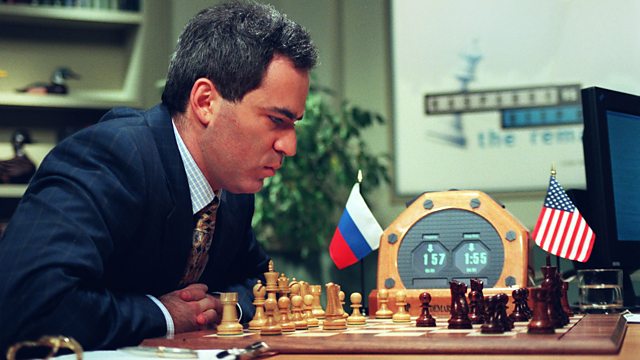
In 1997, Garry Kasparov, widely regarded as the world's greatest chess player, was defeated by a computer. But how much did that reveal about the 'brainpower' of machines?
In 1997, Garry Kasparov, widely regarded as the world's greatest chess player, was defeated by Deep Blue, a computer. But how much did that reveal about the 'brainpower' of machines? Tim Harford explains by delving into the history of algorithms. They've been used by mathematicians and scientists for millennia, but have acquired a new level of power and importance in the digital age.
Last on

Image credit
Sources
Christopher Steiner Automate This New York: Portfolio Penguin 2012; Claude E. Shannon"A Symbolic Analysis of Relay and Switching Circuits". Trans. AIEE. 57 (12): 713–723. 1938
.laude E. Shannon “Programming a Computer for Playing Chess” Philosophical Magazine, Ser.7, Vol. 41, No. 314 - March 1950.
Douglas Hofstadter Gödel, Escher, Bach New York: Basic Books 1979
Chess Grandmaster Garry Kasparov Replays His Four Most Memorable Games, New Yorker, from around 5 minutes in.
James Somers “The Man Who Would Teach Machines to Think” The Atlantic November 2013
CloudCV: Visual Question Answering
Hannah Kuchler “Google AI system beats doctors in detection tests for breast cancer” The Financial Times 1 January 2020
Daniel Susskind A World Without Work London: Allen Lane 2020; AI Index Report 2019
Garry Kasparov “Chess, a Drosophila of reasoning” Science 7 December 2018
Pedro Domingos The Master Algorithm London: Penguin 2017
Broadcasts
- Sat 22 Feb 202005:50GMTBBC World Service Australasia, Americas and the Caribbean, Europe and the Middle East & East Asia only
- Sat 22 Feb 202014:50GMTBBC World Service News Internet
- Sun 23 Feb 202014:50GMTBBC World Service East and Southern Africa & West and Central Africa only
- Sun 23 Feb 202015:50GMTBBC World Service Australasia, UK DAB/Freeview & Online only
- Sun 23 Feb 202022:50GMTBBC World Service
- Mon 24 Feb 202004:50GMTBBC World Service South Asia
Podcast
![]()
50 Things That Made the Modern Economy
The stories of inventions, ideas and innovations which helped create the economic world