The future of freight
Designing an eco-friendly lorry is no easy task but Germany is trying out some promising technologies as it works towards ditching diesel.
Billions of tonnes of goods are moved by lorry every year – everything from food and clothes to building materials, electronic gadgets and toys.
Most heavy-duty vehicles run on diesel and they account for a quarter of the EU’s CO2 emissions from road transport. But making eco-friendly lorries and trucks is challenging. Big vehicles need big batteries, which currently take too long to charge and take up too much room.
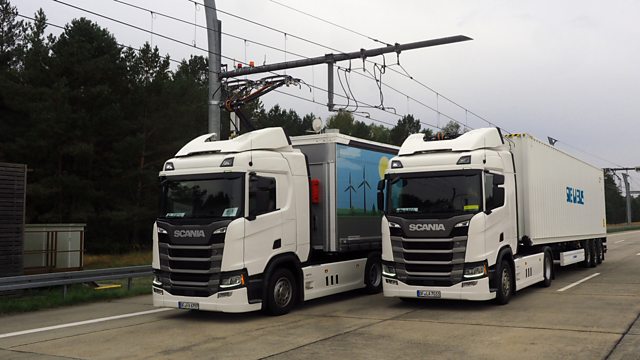
So Germany is trying out a few alternatives. The eHighway system enables lorries to connect to overhead electricity cables, just like trams and trains. And while lorries are connected, smaller on-board batteries could be charged up too to power the final leg of a journey.
The country is also investing in another technology: hydrogen. Fuel cells convert the gas into electricity and the only emissions from these vehicles are water vapour and warm air. Seventy-five hydrogen fuel pumps have already opened across the country.
Reporter: William Kremer
Last on

More episodes
Previous
Broadcasts
- Tue 29 Oct 201903:06GMTBBC World Service Europe and the Middle East & West and Central Africa only
- Tue 29 Oct 201904:06GMTBBC World Service Online & UK DAB/Freeview only
- Tue 29 Oct 201906:06GMTBBC World Service Australasia, Americas and the Caribbean & South Asia only
- Tue 29 Oct 201907:06GMTBBC World Service East and Southern Africa & East Asia only
- Tue 29 Oct 201915:06GMTBBC World Service except East and Southern Africa & West and Central Africa
- Tue 29 Oct 201918:06GMTBBC World Service East and Southern Africa, South Asia & West and Central Africa only
- Tue 29 Oct 201920:06GMTBBC World Service Australasia & Americas and the Caribbean only
- Tue 29 Oct 201921:06GMTBBC World Service News Internet & East Asia only
- Mon 4 Nov 201900:06GMTBBC World Service except East and Southern Africa & West and Central Africa
People fixing the world on YouTube
Watch stories of people changing their world on the World Service English YouTube channel
