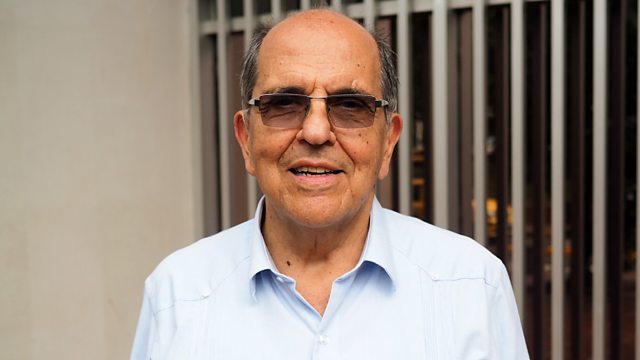
Meeting Colombia’s ‘violentologist’
When Dr Rodrigo Guerrero was mayor of Cali in Colombia in 1992, he approached violence in the same way as a disease. Now, many cities use similar violence reduction methods.
For the past 20 years, police chiefs and policy makers around the world have been fascinated by an idea: that violence spreads through cities like a disease, with patterns of clustering and transmission, and opportunities to inoculate communities against it.
Violence-reduction programmes, influenced by epidemiology, have been implemented in Chicago, Glasgow and - most recently - London. But before these initiatives, a link between violence and disease was made by a Colombian doctor called Rodrigo Guerrero.
When Guerrero became mayor of Cali in Colombia in 1992, the city was in crisis. It was the height of a war between the Cali and Medellin drug cartels with the homicide rate reaching a shocking 120 per 100,000 people.
Guerrero’s approach was not to wage a war against the cartels, or to cave into corruption. Instead, he used his knowledge as a Harvard-trained epidemiologist to gather data about the exact causes of homicide, make hypotheses, and try interventions. “I was no longer an epidemiologist, but a violentologist,” he recalls.
In this programme Dr Guerrero gives reporter William Kremer a tour of his city and explains his approach.
Reporter: William Kremer
(Photo Caption: Dr Rodrigo Guerrero / Photo Credit: BBC)
Last on
Broadcasts
- Tue 10 Sep 201902:06GMTBBC World Service Online, Europe and the Middle East & West and Central Africa only
- Tue 10 Sep 201903:06GMTBBC World Service UK DAB/Freeview
- Tue 10 Sep 201905:06GMTBBC World Service Australasia, Americas and the Caribbean & South Asia only
- Tue 10 Sep 201906:06GMTBBC World Service East and Southern Africa & East Asia only
- Tue 10 Sep 201913:06GMTBBC World Service Australasia
- Tue 10 Sep 201914:06GMTBBC World Service except Australasia
- Tue 10 Sep 201917:06GMTBBC World Service South Asia
- Tue 10 Sep 201919:06GMTBBC World Service except East and Southern Africa, South Asia & West and Central Africa
- Sun 15 Sep 201923:06GMTBBC World Service
People fixing the world on YouTube
Watch stories of people changing their world on the World Service English YouTube channel
