How humans are changing chimpanzee behaviour
Interactions with humans lead to chimpanzees displaying less complex behaviours
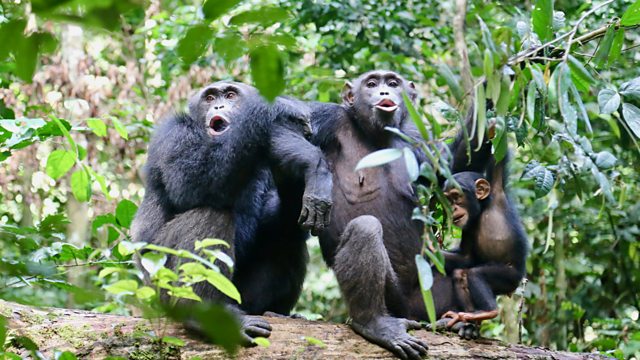
The world’s largest study of chimpanzee behaviour has come to the rather negative conclusion that interactions with humans decrease the range of chimpanzee behaviours and may interfere with the way in which chimp parents pass skills to their offspring.
Chimps learn skills from swimming to digging for insects with sticks and exhibit a wide range of vocal communications. In environments where they may be living near humans such skills or behaviours are displayed less and may be replaced altogether with more human related activities such as raiding crops or rubbish dumps.
And in Mozambique the civil war of the 1990s had huge implication for animals in the Gorongoza national park, eliminating many of the large predators there. A study of a small deer species in the park has shown how prey animals can change their behaviour following a decrease in predators. In this case becoming less fearful.
Approaching the anniversary of the Fukushima nuclear explosion we look at the tiny particles of radioactive debris now providing clues as to what really happened.
And how about making plastic from unwanted atmospheric carbon dioxide? Sounds like an amazing solution, the catch is the huge amount of energy required to make such a process work.
Presenter: Roland Pease
Producer: Julian Siddle
(Photo: Chimpanzees in the Taï National Park, Côte d'Ivoire vocalise with another party nearby. © Liran Samuni/Taï Chimpanzee Project)
Last on

Broadcasts
- Thu 7 Mar 201920:32GMTBBC World Service Online, Americas and the Caribbean, UK DAB/Freeview, Europe and the Middle East & News Internet only
- Thu 7 Mar 201921:32GMTBBC World Service Australasia & East Asia only
- Fri 8 Mar 201905:32GMTBBC World Service Online, UK DAB/Freeview, News Internet & Europe and the Middle East only
- Fri 8 Mar 201906:32GMTBBC World Service Australasia, Americas and the Caribbean & South Asia only
- Fri 8 Mar 201907:32GMTBBC World Service East and Southern Africa & East Asia only
- Fri 8 Mar 201911:32GMTBBC World Service West and Central Africa
- Fri 8 Mar 201914:32GMTBBC World Service Australasia
- Fri 8 Mar 201918:32GMTBBC World Service East and Southern Africa, South Asia & West and Central Africa only
- Mon 11 Mar 201901:32GMTBBC World Service
Podcast
![]()
Science In Action
The BBC brings you all the week's science news.