Beyond the Planets
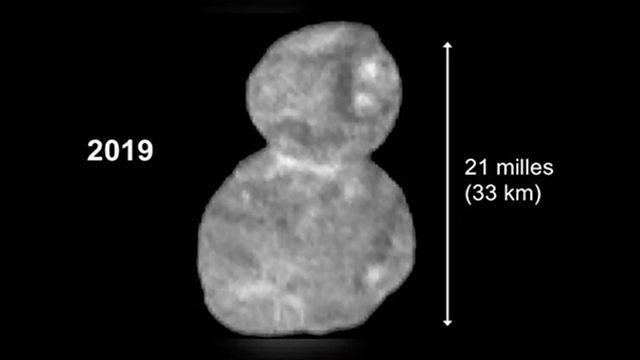
Nasa’s Fly-by of Ultima Thule, the most distant visited object in our solar system
It has been years in the planning and involved a tiny window of opportunity. Nasa’s New Horizons mission launched in 2006 has reached its far flung destination, a couple of outer space snowballs known as Ultima Thule. The mission aims to shed light on the formation of our solar system.
And just days later an unmanned Chinese mission has landed on the moon, on the far side, they’ll be examining rocks and also seeing if simple plants and animals survive in a biosphere there.
We also look at the Indonesian Anak Krakatau volcano, which has erupted recently. Just why did it collapse into the sea creating a tsunami, and why is it so difficult to predict the impact of volcanic eruptions?
And we celebrate the periodic table,150 years old this year, this chart of chemical elements found on the walls of classrooms around the world still has much to reveal.
(Photo: The first high-definition picture of Ultima Thule, Credit: Nasa)
Presenter: Roland Pease
Producer: Julian Siddle
Last on

More episodes
Previous
Broadcasts
- Thu 3 Jan 201920:32GMTBBC World Service Online, Americas and the Caribbean, UK DAB/Freeview, News Internet & Europe and the Middle East only
- Thu 3 Jan 201921:32GMTBBC World Service Australasia & East Asia only
- Fri 4 Jan 201905:32GMTBBC World Service Online, UK DAB/Freeview, News Internet & Europe and the Middle East only
- Fri 4 Jan 201906:32GMTBBC World Service Australasia, Americas and the Caribbean & South Asia only
- Fri 4 Jan 201907:32GMTBBC World Service East and Southern Africa & East Asia only
- Fri 4 Jan 201911:32GMTBBC World Service West and Central Africa
- Fri 4 Jan 201914:32GMTBBC World Service Australasia
- Fri 4 Jan 201918:32GMTBBC World Service East and Southern Africa, South Asia & West and Central Africa only
- Mon 7 Jan 201901:32GMTBBC World Service
Podcast
![]()
Science In Action
The BBC brings you all the week's science news.