The Algae that Changed the Earth
Three billion years ago, life was suddenly transformed. Also, 40 years since the launch of Voyager, techniques used to identify dead bodies and a total solar eclipse.
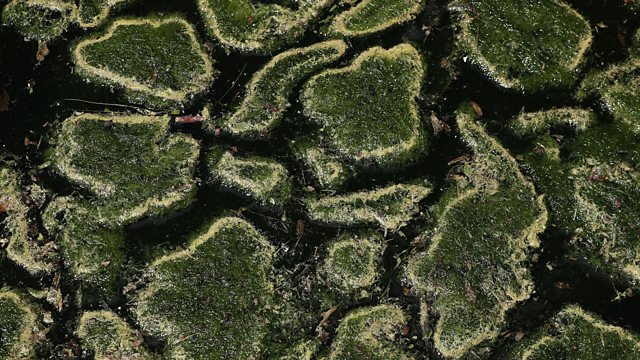
The earliest life forms on Earth were bacteria, but three billion years ago, life was suddenly transformed. Eukaryotes - precursors to all plants and animals - took over. The evidence has only just been found in algae microfossils.
In August and September 1977, Nasa's probes Voyager 2 and Voyager 1 were launched. Since then the two spacecraft have been exploring our Solar System and interstellar space. Exceeding all expectations, the probes have taught us so much about our planets and beyond. The Voyager mission's chief scientist, Professor Ed Stone, looks back over Voyager's highlights.
Much like Europe, South Africa is experiencing an increase in the number of undocumented migrants. Who, when they die, can be hard to identify. Forensic scientists are looking at radioisotopes to try to work out the origin of migrants whose journey has tragically ended in the mortuary.
On Monday 21st of August 2017, a 70km wide stripe of the continental United States will go dark, as the Moon blocks out the Sun. It has been nearly a century since the United States experienced a total solar eclipse from coast to coast.
Presenter: Roland Pease
Producer: Caroline Steel
Main image: Algae floods in a pond (Credit: Getty Images, Alex Wong)
Last on
More episodes
Broadcasts
- Thu 17 Aug 201719:32GMTBBC World Service except News Internet
- Fri 18 Aug 201702:32GMTBBC World Service Americas and the Caribbean
- Fri 18 Aug 201704:32GMTBBC World Service except Americas and the Caribbean, East and Southern Africa, News Internet & West and Central Africa
- Fri 18 Aug 201706:32GMTBBC World Service East and Southern Africa
- Fri 18 Aug 201713:32GMTBBC World Service Australasia
- Sun 20 Aug 201700:32GMTBBC World Service except News Internet
Podcast
![]()
Science In Action
The BBC brings you all the week's science news.