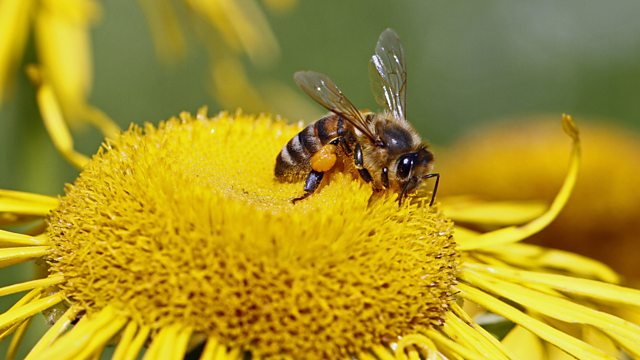
Neonicotinoids Harm Bees
Neonicotinoids harm bees. Also the effect of Antarctic warming on its terrestrial biodiversity and celestial sleuthing of Byron’s poems
The first large-scale, field studies looking at the impact of neonicotinoid pesticides on bees show largely negative effects. It’s been suspected for a number of years now, that the systemic, seed-coating, pesticides affect the survival and reproductive success of honeybees and wild bees. But testing this in the field, where other factors have to be ruled out, has so far proved very difficult. Now, the results from trials in the UK, Hungary and Germany, as well as separate trials in Canada, are affirming these concerns. The picture is still complicated, and it seems other factors, such as diet, disease and stress also play a role. But perhaps most concerning is the persistence and spread of these chemicals in the environment.
Antarctic Terrestrial Biodiversity
You might be surprised at just how many plants and animals live on Antarctica. Aside from penguins and seasonally nesting seabirds, the icy continent is home to grasses, mosses, lichens, springtails and other invertebrates. They survive in ice-free patches. 1% of the continent is thought to be permanently ice-free, in places such as the coast, on the steep sides and tops of mountains and in dry valleys. You’d think that with global warming predicted to increase these ice-free areas by 25% over the next 100 years, it would be a good thing – more habitat and a less harsh climate. But concerns about an increase in invasive species could threaten the survival of this terrestrial Antarctic biodiversity.
‘Celestial Sleuth’ Identifies Lord Byron’s ‘Single Star’
Exactly 200 years ago, poet Lord Byron was so impressed by a night’s sky that he wrote about it in his seminal narrative poem “Childe Harold’s Pilgrimage”. The problem was, when he spoke of “The Moon is up...” as he wrote in the fourth canto, published in 1818, “…A Single Star is at her side.” He got it wrong! Celestial sleuth and Texas State University astronomer and physicist, Professor Donald Olson, has deduced the exact night, in August 1818, that Byron recalls, and the star was in fact not a star, but the planet Jupiter. However, the magnificent twilight colours of which he also waxes lyrical “of all colours seem to be melted to one vast Iris of the west…” is a correct observation, as the dust from the massive 1815 eruption of the Tambora volcano in Indonesia would have been creating some spectacular sunsets at that time.
Childe Harold’s Pilgrimage, Canto IV
Stanza XXVII.
The Moon is up, and yet it is not Night -
Sunset divides the sky with her -- a Sea
Of Glory streams along the Alpine height
Of blue Friuli’s mountains; Heaven is free
From clouds, but of all colours seems to be
Melted to one vast Iris of the West,
Where the Day joins the past Eternity;
While, on the other hand, meek Dian’s crest
Floats through the azure air -- an island of the blest!
Stanza XXVIII.
A Single Star is at her side, and reigns
With her o’er half the lovely heaven; but still
Yon sunny Sea heaves brightly, and remains
Rolled o’er the peak of the far Rhaetian hill,
As Day and Night contending were, until
Nature reclaimed her order -- gently flows
The deep-dyed Brenta, where their hues instil
The odorous Purple of a new-born rose,
Which streams upon her stream, and glassed within it glows,
Stanza XXIX.
Filled with the face of Heaven, which, from afar,
Comes down upon the waters; all its hues,
From the rich sunset to the rising star,
Their magical variety diffuse:
And now they change; a paler Shadow strews
Its mantle o’er the mountains; parting Day
Dies like the Dolphin, whom each pang imbues
With a new colour as it gasps away -
The last still loveliest -- till -- ‘tis gone -- and All is gray.
Photo: Honey bee, credit: Paul F Donald
Presenter: Roland Pease
Producer: Fiona Roberts
Last on

Broadcasts
- Thu 29 Jun 201719:32GMTBBC World Service except News Internet
- Fri 30 Jun 201702:32GMTBBC World Service Americas and the Caribbean
- Fri 30 Jun 201704:32GMTBBC World Service except Americas and the Caribbean, East and Southern Africa, News Internet & West and Central Africa
- Fri 30 Jun 201706:32GMTBBC World Service East and Southern Africa
- Fri 30 Jun 201713:32GMTBBC World Service Australasia
- Sun 2 Jul 201700:32GMTBBC World Service except News Internet
Podcast
![]()
Science In Action
The BBC brings you all the week's science news.