Extending Embryo Research
Explorations in the world of science.
Since the birth of Louise Brown - the world’s first IVF baby - in England in 1978, many children have been born through in vitro fertilisation. IVF doesn’t work for everyone but over the last few decades basic research into human reproduction has brought about huge improvements.
In the UK the Human Fertilisation and Embryology Act, passed in 1990, made it illegal for research on human embryos to be permitted beyond 14 days. In a dozen other countries, from Canada and Australia to Iceland and South Korea the 14 day limit is enshrined in law and in five others, including China, India and the US, there are guidelines that recommend that limit.
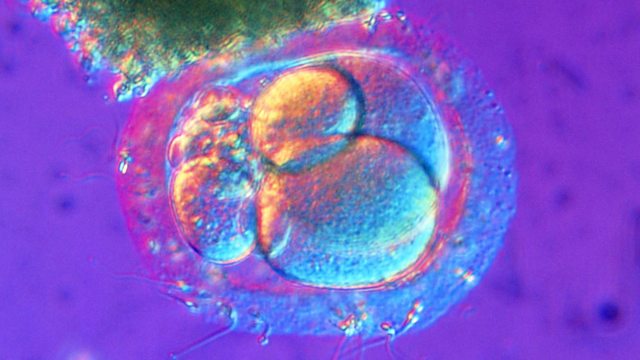
Just recently researchers at Cambridge University have kept embryos alive in the lab for 13 days. They and others are calling for the limit to be extended for another one or two weeks, so they can study why early pregnancies fail. Matthew Hill reports on the issues raised by these new developments in embryo research.
Image: Light micrograph of fertilized human egg cell © Science Photo Library
Last on
More episodes
Previous
Broadcasts
- Mon 27 Mar 201719:32GMTBBC World Service except News Internet
- Tue 28 Mar 201702:32GMTBBC World Service Americas and the Caribbean
- Tue 28 Mar 201704:32GMTBBC World Service Online, Australasia, Europe and the Middle East & UK DAB/Freeview only
- Tue 28 Mar 201705:32GMTBBC World Service South Asia
- Tue 28 Mar 201706:32GMTBBC World Service East and Southern Africa & East Asia only
- Tue 28 Mar 201713:32GMTBBC World Service Australasia
Space

The eclipses, spacecraft and astronauts changing our view of the Universe
The Curious Cases of Rutherford and Fry

A pair of scientific sleuths answer your perplexing questions. Ask them anything!
Podcast
![]()
Discovery
Explorations in the world of science.