Robots threaten the human workforce, but their ubiquity and growing competence make them crucial to the modern economy.
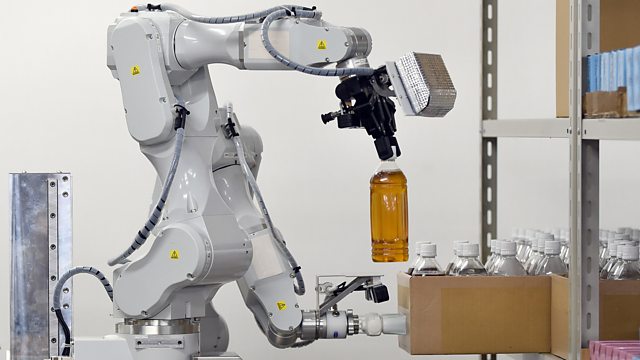
Robots threaten the human workforce, but their ubiquity and growing competence make them crucial to the modern economy. In 1961 General Motors installed the first Unimate at one of its plants. It was a one-armed robot resembling a small tank that was used for tasks like welding. Now, as Tim Harford explains, the world’s robot population is expanding rapidly (the robot “birth rate” is almost doubling every five years) and, coupled with rapid advances in artificial intelligence, robots are changing the world of work in unexpected ways.
(Photo: Robot, Credit: Toru Yamanaka/Getty Images)
Last on

Sources and related links
Nick Bostrum - Superintelligence: Paths, Dangers, Strategies, OUP, 2014
Klaus Schwab - The Fourth Industrial Revolution, World Economic Forum, 2016
Hitachi developing dual-armed robot for warehouse picking
Inside Amazon's warehouse, Human-Robot symbiosis
Will the rise of the robots implode the world economy?
UNIMATE//The first industrial robot
Rethink robotics lets industrial robots work alongside people
7 companies that are replacing human jobs with robots
10 jobs robots already do better than you
This incredible hospital robot is saving lives. Also, I hate it
Rosie the robot won't be cleaning your house anytime soon
The future of "sense and avoid" drones
Broadcasts
- Sat 4 Mar 201719:50GMTBBC World Service except Americas and the Caribbean, East and Southern Africa, News Internet & West and Central Africa
- Sun 5 Mar 201711:50GMTBBC World Service except News Internet
- Mon 6 Mar 201704:50GMTBBC World Service Australasia
- Tue 7 Mar 201723:50GMTBBC World Service Americas and the Caribbean
Podcast
![]()
50 Things That Made the Modern Economy
The stories of inventions, ideas and innovations which helped create the economic world