Making Metallic Hydrogen
Metallic hydrogen made in the lab. Also, what are the implications of human-animal chimeras? The Falklands Island Wolf and custom MEG helmet gives better readings of brain currents
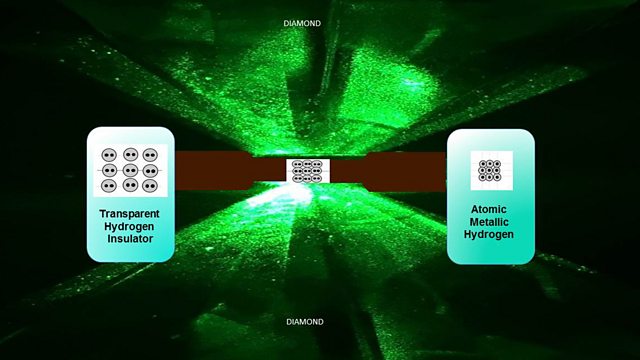
For more than 80 years, it has been predicted that hydrogen will adopt metallic properties under certain conditions, and now researchers have successfully demonstrated this phenomenon. Theoretically, metallic hydrogen will have many qualities important in the realm of physics, including high temperature superconductivity and super-fluidity, which could hold valuable implications for solving energy problems.
Human/Animal Chimeras
Efforts to grow the first embryos containing cells from humans and pigs are proving more challenging than anticipated. Human/animal chimeras are not without controversy. However, supporters say they can offer insights into early human development and disease onset and provide a realistic drug-testing platform. And they may also someday provide a means of growing human cells, tissues, and organs for regenerative medicine.
Quantum Brain Sensors
Roland sees the new laser-based sensors that can peer into the electrical activity of the brain.
The Falklands Island Wolf
Scientists unravel the mysterious natural history of the Falklands Island Wolf. It was first spotted and described by Charles Darwin. The now extinct ‘wolf’ is thought to be an ancestor of a jackal-like creature which crossed the shallow, sometimes frozen sea from South America.
Image of diamond anvils compressing molecular hydrogen. At higher pressure the sample converts to atomic hydrogen, as shown on the right.
[Credit: R. Dias and I.F. Silvera]
Presenter: Roland Pease
Producer: Fiona Roberts
Last on

More episodes
Broadcasts
- Thu 26 Jan 201719:32GMTBBC World Service East and Southern Africa & West and Central Africa only
- Thu 26 Jan 201720:32GMTBBC World Service Online, Americas and the Caribbean, Australasia, Europe and the Middle East & UK DAB/Freeview only
- Thu 26 Jan 201721:32GMTBBC World Service East Asia & South Asia only
- Fri 27 Jan 201702:32GMTBBC World Service Americas and the Caribbean
- Fri 27 Jan 201703:32GMTBBC World Service Online, Europe and the Middle East & UK DAB/Freeview only
- Fri 27 Jan 201704:32GMTBBC World Service East Asia & South Asia only
- Fri 27 Jan 201705:32GMTBBC World Service Australasia
- Fri 27 Jan 201707:32GMTBBC World Service East and Southern Africa & Europe and the Middle East only
Podcast
![]()
Science In Action
The BBC brings you all the week's science news.