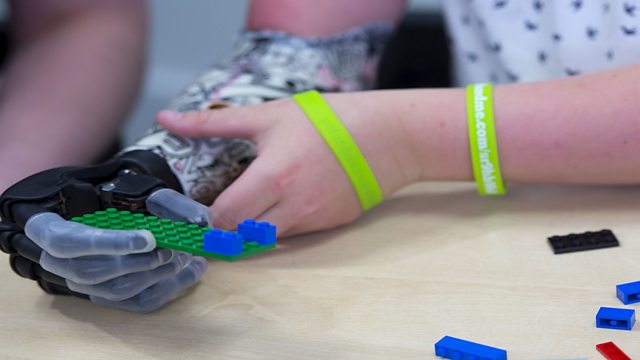
Bionic Bodies for Superhuman Powers?
How advances in bionics is enhancing the human body, including a bionic eye for the blind.
The field of bionics has transformed medicine for centuries, as far back as the ancient Egyptians who created bespoke toes from wood and leather. During the 20th Century mechanical and electronic advances made heart pacemakers and more sophisticated prosthetic limbs possible.
Now, researchers are creating bionic eyes to help blind people see again. Neurosurgeon Jeffrey Rosenfeld, director of the Monash Institute of Medical Engineering in Australia, hopes to implant tiny “ceramic micro-electrode tiles” into the brain’s visual cortex of blind volunteers this year – bypassing the normal visual pathway. A digital camera mounted on a pair of glasses captures images which are then processed in a device about the size of a mobile phone. The resulting image is then transferred wirelessly to the tiles in the brain – the more tiles, the more detailed the image.
Such techniques designed to help people with disabilities could also be adopted by others wanting to enhance their own senses or performance. Anders Sandberg, senior researcher at the Future of Humanity Institute at Oxford University, ponders over the ethics of bionics. He supports morphological freedom – the right to modify our bodies – but also the right to say no.
(Photo: Bionic hand. Credit: Mark Runnacles/GettyImages)
Last on
More episodes
Broadcasts
- Wed 4 Jan 201719:32GMTBBC World Service East and Southern Africa & West and Central Africa only
- Wed 4 Jan 201720:32GMTBBC World Service Online, Australasia, Americas and the Caribbean, Europe and the Middle East & UK DAB/Freeview only
- Wed 4 Jan 201721:32GMTBBC World Service South Asia & East Asia only
- Thu 5 Jan 201702:32GMTBBC World Service Americas and the Caribbean
- Thu 5 Jan 201703:32GMTBBC World Service Online, Europe and the Middle East & UK DAB/Freeview only
- Thu 5 Jan 201704:32GMTBBC World Service East Asia & South Asia only
- Thu 5 Jan 201705:32GMTBBC World Service Australasia
- Thu 5 Jan 201707:32GMTBBC World Service Europe and the Middle East & East and Southern Africa only
Podcast
![]()
Health Check
Health issues and medical breakthroughs from around the world.