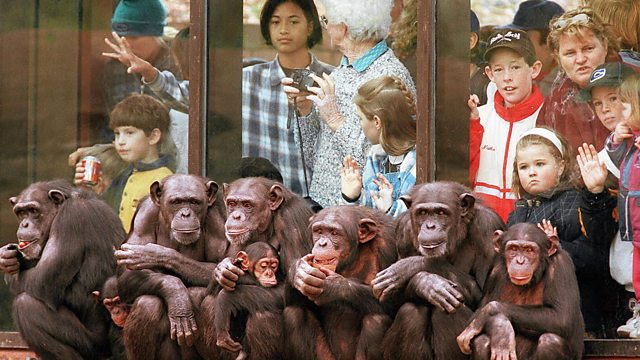
Origins of Human Culture
Why humans have complex culture and our close cousins, the great apes, don’t.
We humans are such a successful species. Homo sapiens have been around for only around 100 000 years and in that time we have utterly transformed the world around us. Our shelters allow us to live in all climates and from the poles to the tropics; our technology lets us communicate across the planet. We’ve created art and music and literature; and our agriculture has changed global biodiversity, shifting forever the way we feed ourselves. In other words, human culture dominates the earth. Gaia Vince finds out what has given us the cultural edge over other animals. This includes our closest relatives – the great apes – with whom we share over 95% of our genes.
She meets researchers at Birmingham University comparing the abilities of chimps and human children, and has a go at making a prehistoric stone hand axe by flint knapping.
Photo credit: William West/AFP/Getty Images
Last on

More episodes
Broadcasts
- Mon 5 Dec 201619:32GMTBBC World Service East and Southern Africa & West and Central Africa only
- Mon 5 Dec 201620:32GMTBBC World Service Online, Americas and the Caribbean, Australasia, Europe and the Middle East & UK DAB/Freeview only
- Mon 5 Dec 201621:32GMTBBC World Service East Asia & South Asia only
- Tue 6 Dec 201602:32GMTBBC World Service Americas and the Caribbean
- Tue 6 Dec 201603:32GMTBBC World Service Online, UK DAB/Freeview & Europe and the Middle East only
- Tue 6 Dec 201604:32GMTBBC World Service East Asia & South Asia only
- Tue 6 Dec 201605:32GMTBBC World Service Australasia
- Tue 6 Dec 201607:32GMTBBC World Service East and Southern Africa & Europe and the Middle East only
Space

The eclipses, spacecraft and astronauts changing our view of the Universe
The Curious Cases of Rutherford and Fry

A pair of scientific sleuths answer your perplexing questions. Ask them anything!
Podcast
![]()
Discovery
Explorations in the world of science.