Country Down Under
How country music became a powerful form of expression for Australia’s Aboriginal peoples.
Country music is commonly associated with downtrodden, lovelorn, white inhabitants of America’s rural south, but it has also long been a significant form of expression for Australia’s Aboriginal peoples.
Country music became popular 'down under' during the first half of the 20th Century. Thanks to gramophone recordings, wind-up radios and touring bands, it even reached the bush where most Aboriginals lived, often more or less imprisoned on missions and government-controlled reserves. At a time when their own cultural heritage was being systematically erased, country music became a medium through which they could maintain their practice of sharing stories via the oral tradition. Its resonance was enhanced by melodies which tended towards the melancholic. As one musician put it “country music was all about loss, and we’d lost everything”.
Through country music, Aboriginal people were able to give voice to their personal experiences and ongoing struggles for justice. Songs describe, for example, how babies and land were stolen, incidents of racism, poor living conditions, and high levels of incarceration. Country music, far from its origins, has thus become a deeply moving and powerful Aboriginal activism art form. With contributions from Auriel Andrew, Kev Carmody, Roger Knox, Sue Ray, Glenn Skuthorpe and Clinton Walker.
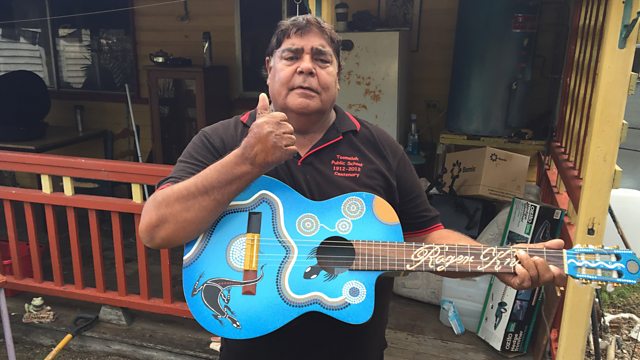
(Photo: Roger Knox with his guitar)
Last on
More episodes
Previous
Broadcasts
- Wed 16 Nov 201600:32GMTBBC World Service except News Internet
- Wed 16 Nov 201603:32GMTBBC World Service Americas and the Caribbean
- Wed 16 Nov 201605:32GMTBBC World Service South Asia, UK DAB/Freeview, Online & Europe and the Middle East only
- Wed 16 Nov 201606:32GMTBBC World Service East Asia
- Wed 16 Nov 201607:32GMTBBC World Service Australasia
- Wed 16 Nov 201609:32GMTBBC World Service Americas and the Caribbean
- Wed 16 Nov 201613:32GMTBBC World Service except Americas and the Caribbean & News Internet
- Wed 16 Nov 201619:32GMTBBC World Service except East and Southern Africa, News Internet & West and Central Africa
- Wed 16 Nov 201621:32GMTBBC World Service East and Southern Africa & West and Central Africa only
- Sun 20 Nov 201619:32GMTBBC World Service East and Southern Africa
- Mon 21 Nov 201607:32GMTBBC World Service East Asia
