Looping Swans
Tchaikovsky’s ballet classic Swan Lake and its elaborate relationship with the Russian psyche and politics.
When tanks rolled into Moscow on 19 August 1991 during a dramatic anti-Perestroika coup by Soviet hardliners, the USSR’s state-controlled airwaves offered a curious response - a continuous loop of Tchaikovsky’s Swan Lake. Ballet, of all things, served as balm for the revolution underway.
Yet most Soviets were not fooled. A series of deaths by recent Soviet premiers – all greeted by broadcasts of the regime’s beloved ‘Swans’ on television – had taught Russians to view Tchaikovsky’s classic as far more than art. It was a harbinger for political wrangling deep inside the Kremlin. Amid the dancing and pirouettes on a grainy screen, Russians saw hidden choreography affecting their lives and country. Tchaikovsky's swans had become canaries in the coal mine, sparking mass protests that brought an end to the Soviet empire.
We trace the strange and elaborate pas de deux between Tchaikovsky’s ballet classic and the Russian psyche – revealing how a work, considered a flop upon its premiere, emerged as a powerful instrument of Soviet propaganda, and later – a soundtrack that failed to disguise impending political turmoil.
A mosaic of Russian voices recall their impressions of the swans through a richly layered tale of 'looped reporting' and encounters, rare archive audio, contemporary interviews and digital mash-ups, to chronicle how Swan Lake has shaped the history of modern Russia and – even now – emerged as a powerful political 'meme' in the Putin era. With Swan Lake loops by Rombix.
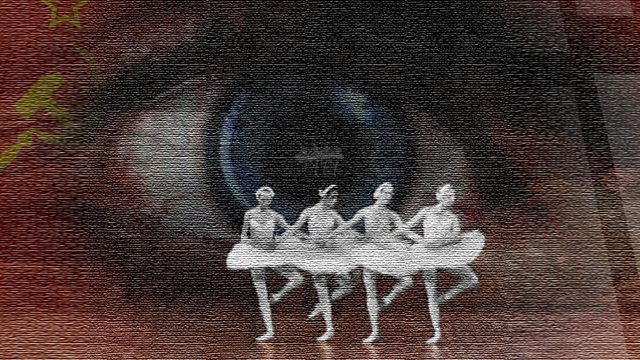
(Photo: Ballerinas dancing in front of an image of a human eye)
Last on

Broadcasts
- Wed 24 Aug 201602:32GMTBBC World Service Americas and the Caribbean
- Wed 24 Aug 201604:32GMTBBC World Service Online, Europe and the Middle East, South Asia & UK DAB/Freeview only
- Wed 24 Aug 201605:32GMTBBC World Service East Asia
- Wed 24 Aug 201606:32GMTBBC World Service Australasia
- Wed 24 Aug 201612:32GMTBBC World Service except News Internet
- Wed 24 Aug 201618:32GMTBBC World Service except East and Southern Africa, News Internet & West and Central Africa
- Wed 24 Aug 201619:32GMTBBC World Service East and Southern Africa & West and Central Africa only
- Mon 29 Aug 201606:32GMTBBC World Service East Asia
