Can we Quake-Proof a City?
Earthquakes have killed a million people in the last two decades. From shacks to skyscrapers, what more could we do to minimise deaths and destruction?
They are at once the most predictable and unpredictable killers. We know continent-sized slabs of earth are moving beneath our feet. We know they move at a speed that is often harmless - the same rate as our fingernails grow. But sometimes, without warning, they can slip tens of metres in a second - and bring down whole cities. About a million people have died in earthquakes in the last two decades, most in a handful of huge quakes in urban areas. Yet the populations of cities at risk continue to grow. So, how can we quake-proof a city?
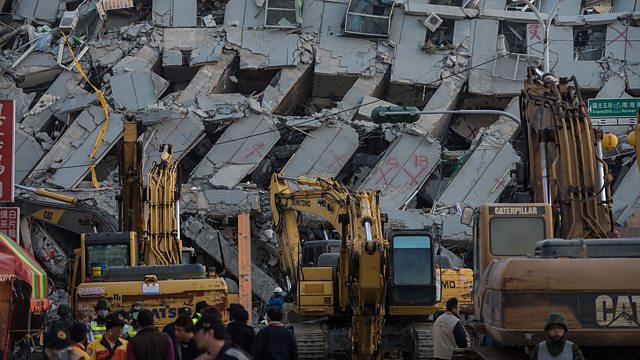
(Photo: A general view shows excavator vehicles and rescue workers in front of a building which collapsed in the 6.4 magnitude earthquake, in the southern Taiwanese city of Tainan early on 9 February, 2016. Credit: Getty Images)
Last on

Clips
![]()
The earthquake information gap
Duration: 02:19
![]()
"It just becomes dead weight and falls on the people inside"
Duration: 01:20
Broadcasts
- Tue 22 Mar 201602:06GMTBBC World Service Americas and the Caribbean
- Tue 22 Mar 201603:06GMTBBC World Service Online, UK DAB/Freeview & East Asia only
- Tue 22 Mar 201604:06GMTBBC World Service South Asia
- Tue 22 Mar 201605:06GMTBBC World Service Australasia
- Tue 22 Mar 201607:06GMTBBC World Service East and Southern Africa
- Sun 27 Mar 201603:06GMTBBC World Service except News Internet
Podcast
![]()
The Inquiry
The Inquiry explores the trends, forces and ideas shaping the world