Into Orbit
How science, engineering and medicine are trying to understand the limits of human physiology to ensure survival in space.
Forty years ago the Apollo-Soyuz mission, with its symbolic handshake between American and Russian astronauts, became one of the most significant political events of its time – heralding the beginning of international co-operation in the human exploration of space. If we want humans to properly explore the cosmos then we have to learn how stay alive in space.
Dr Kevin Fong has been delivering the 2015 London Royal Institution’s Christmas lectures on how to survive in space, and for the BBC World Service he begins a two part investigation into the extraordinary ways that science, engineering and medicine come together to get that fragile human life safely into space. He explores what we need to do to prepare for much longer duration space flights that probe deeper into our solar system and perhaps even beyond.
Kevin begins by taking us on a journey from planet Earth to escape earth’s gravity into Low Earth Orbit and to the International Space Station, which many see as a training ground for human survival in the harsh vacuum of space. Kevin hears from astronauts, aerospace engineers on how the International Space Station is helping to stretch the limits of our understanding of human physiology and survival in a way that no experiment back on Earth could.
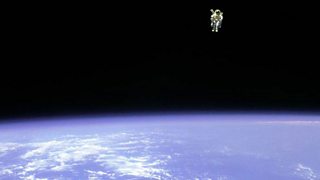
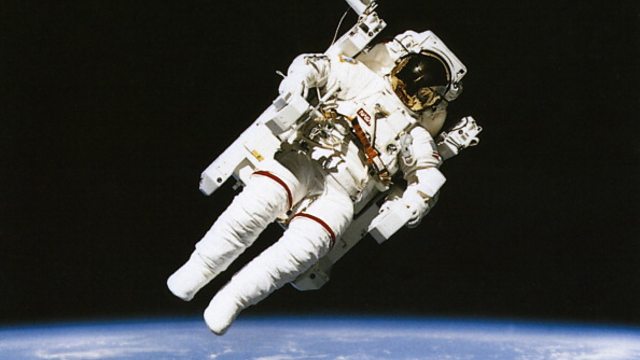
(Photo: An astronaut in space. Credit: Nasa)
Last on
More episodes
Previous
You are at the first episode
Broadcasts
- Wed 30 Dec 201520:32GMTBBC World Service Online, Europe and the Middle East, UK DAB/Freeview & Americas and the Caribbean only
- Wed 30 Dec 201521:32GMTBBC World Service East Asia, South Asia, West and Central Africa & Australasia only
- Thu 31 Dec 201502:32GMTBBC World Service Americas and the Caribbean
- Thu 31 Dec 201503:32GMTBBC World Service Online, UK DAB/Freeview, Europe and the Middle East & East Asia only
- Thu 31 Dec 201504:32GMTBBC World Service South Asia
- Thu 31 Dec 201505:32GMTBBC World Service Australasia
- Thu 31 Dec 201507:32GMTBBC World Service East and Southern Africa & Europe and the Middle East only
- Thu 31 Dec 201513:32GMTBBC World Service UK DAB/Freeview & Online only
- Thu 31 Dec 201514:32GMTBBC World Service West and Central Africa, East and Southern Africa, Europe and the Middle East, East Asia & South Asia only
Featured in...
![]()
Space
The eclipse, visionary astronomers and our fascination with the cosmos