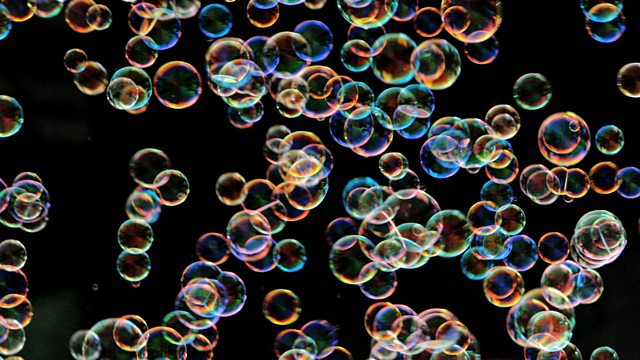
Bubbles
Exploring bubbles, those magical - and ultimately fragile - spherical cavities. With Helen Czerski, Constantin Coussios and Bradley Hart.
Fragile gas filled spheres, sparkling champagne globules that fill your nose with fizz, pipe dreams that pop when the illusion grows too big: the Forum explores the mysterious world of bubbles. Bridget Kendall is joined by bubble physicist Helen Czerski, biomedical engineer Constantin Coussios and artist Bradley Hart who makes giant paintings using bubble wrap.
Photo credit: Associated Press
Last on

More episodes
Next
Clips
Chapters
Helen Czerski
How bubbles help the oceans breathe
Duration: 13:44
Constantin Coussios
Therapeutic uses of bubbles in medicine
Duration: 04:23
60 Second idea
Telescopic ocean goggles
Duration: 05:04
Bradley Hart
Turning a ‘dumb’ material into art
Duration: 12:15
Helen Czerski
![Helen Czerski]()
Helen Czerski is a physicist and oceanographer at University College London. She explains why ocean bubbles are essential for the planet’s wellbeing and describes the difficulties of studying them in the middle of ferocious Atlantic storms.
Constantin Coussios
![Constantin Coussios]()
Constantin Coussios is Professor of Biomedical Engineering at Oxford University. He puts micro-bubbles inside the human body, tracking the tiny nano sized spheres as they make their way through the blood stream. He wants to control the bubbles so they release the cancer drugs encased in them at exactly the right place and right time.
Bradley Hart
![Bradley Hart]()
Visual artist Bradley Hart exploits the curious properties of bubbles which make them such powerful metaphors for our digital, pixelated, disjointed times. He injects paint into bubble wrap, to create large-scale works of art.
You can see some of Bradley's bubble wrap art work in the gallery on the right.
Photo c/o Bradley Hart
60 Second Idea to Change the World
![60 Second Idea to Change the World]()
Helen Czerski proposes a pair of telescopic goggles that let you see into the ocean the way you can see into the sky. You’d see whales and the giant squid and vast puffs of drifting phytoplankton like clouds, showing where the ocean currents were going. You’d see the “weather” of the ocean: it’s all moving around down there, and you’d get a feel for what it’s doing. And – hopefully – the goggles would show us why the ocean really matters for us and help us respect it more. Photo of Plankton by BBC
Broadcasts
- Sat 9 Aug 201421:06GMTBBC World Service Online
- Sun 10 Aug 201409:06GMTBBC World Service Online
- Mon 11 Aug 201402:06GMTBBC World Service Online



Podcast
![]()
The Forum
The programme that explains the present by exploring the past

Related Content
