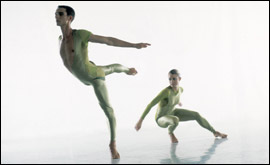
By Pei Ling Wong Artistic director Mark Baldwin led Britain's oldest dance company in marrying ballet with contemporary dance techniques and past masterworks with modern interpretations. The performance was greatly enhanced by the accompaniment of London Musici, conducted by Paul Hoskins. 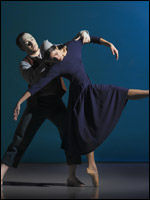 | | Rambert (c) Patrick Baldwin |
The first piece, Judgement of Paris, is a black comedy based on the Greek myth in which three goddesses: Juno, Venus and Minerva compete to be the most beautiful, as judged by Paris. Choreographer Antony Tudor (a.k.a. The Master of Psychological Ballet) portrays in this work three aging prostitutes vying for the custom of the bar's only patron. A combination of clumsily amateur dances by the prostitutes in their bid to be chosen was both comical and pitiful. Rambert dancer Mikaela Polley choreographed the next piece, Momenta. What followed was a frenzy of well-charted and graceful dance movements. The synergy and harmony of the performance is the strong point of this piece. In another choreograph of Tudor, Dark Elegies, the audience were mesmerized by the beautiful voice of baritone Ashley Holland. The Songs on the Death of Children (Kindertotenlieder) sets the loose storyline for this plot-less 20th century ballet. The general impression is of a disaster involving groups of children. 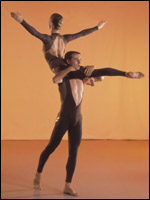 | | Swamp |
Swamp, the final piece, would wake anyone up! Michael Clark uses a creative blend of lighting, costume and loud music in his choreography. It is as if Sir Anthony Caro's sculptures were brought to life. The galvanising performance maintained a graceful combination of movements, which is a trademark of these internationally acclaimed dancers by now. The Rambert Dance Company has put up an impressive performance that is purely to be experienced and enjoyed. |