| WEB LINKS | | Oxford Playhouse
The BBC is not responsible for the content of external websites. |
|  |
| | From the moment you enter the foyer of the Playhouse, you are surrounded by seventeenth-century France.
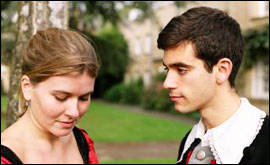
Already in costume and very much in character, the company sell their wares, argue loudly, drink wine from the bottle, and generally conform to the French stereotype.Undoubtedly the star of the show in the title role, Gethin Anthony gives a good account of Cyrano de Bergeracs descent from hero to lonely old man with his posture and delivery alone. His sensitive portrayal of a sensitive poet who just happens to be good with a sword is nothing short of brilliant. The dark balcony scene of Act III, so readily parodied in Blackadder, brings to light the weakest and strongest characters. George Grumbar (Christian de Neuvillette) makes the best of a shallow character who cannot express himself and has nothing very interesting to say. Christian is upstaged by the thin-voiced Compte de Guiche, played by Neil Gatland. Gatland has the audience expecting something special every time he swaggers onto the stage, an expectation which is always rewarded with one of the many comic tricks up the actor's large sleeve. Burgesss adaptation of the timeless Rostand original requires a cast of 60; this student-run production has cut this number to 18, but with no loss of collective stage presence. With one exception where the action is frustratingly invisible from the stalls due to a transvestite lady-in-waiting spreading herself across the front of the stage, the layout of the stage is superb, and no part of it is ever empty. Above all, the audience understands that the cast are enjoying themselves; we are immersed in seventeenth-century France and feel a part of the society being depicted.
Under Helen Browns direction, Cyrano de Bergerac is performed as it should be: a fun play about a society full of personal tragedies.
*The views expressed in these comments are those of the contributor's and not the BBC.
|