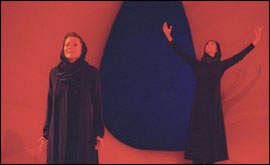
By Simon Tavener This was always going to be a controversial production. Peter Sellars, the enfant terrible of stage directors, always elicits an extreme response from audiences. It is a love/hate thing. Glyndebourne can always be relied upon to present a very high level of musical preparation. This production was no exception. Mozart's score is one of his most innovative; it blends intense periods of accompanied recitative with deeply moving arias. The choral writing is some of the most dramatic in all of Mozart's operas - the chorus were particularly impressive in their control and power. Vocally the stars of the evening were Peter Bronder in the title role and Marie Arnet as Ilia. Bronder was able to convey the torment his character faced whilst maintaining a near perfect technique. His pianissimo singing at the very end of the opera was one of the most involving moments I have experienced in an opera house. Arnet was in very fine voice - delicate, lyrical and precise. She coped excellently with the physical demands placed on her by the stage directions and never let it interfere with her vocal production. Clearly a voice to watch for the future. I have to admit to being a little disappointed in Julianne de Villiers as Idamante. She has a good instrument but she found it difficult to project over the orchestra when using the lower part of her range. Hopefully this is something that will improve with further experience as most of her performance was excellent. Peter Sellars, as previously mentioned, is a challenging director. I would have welcomed some clearer indication as to what he was trying to achieve with his production. There were elements of the recent Balkan conflict, intimations of 80s power politics and hints of the ongoing differences between Christian and Islamic cultures - but nothing was made explicit. Visually the production was rich in colour and gesture (one of Sellars' trademarks). The lighting was both subtle and bold - constantly shifting to reflect both mood and emotion. However I was left somewhat underwhelmed by the over-literal use of movement to reinforce the libretto. To my mind, it is not necessary to mime a snake when reference is made to one in the text. From time to time, laughs could be heard to spread round the auditorium when such examples were played out on stage. Having said this, it is still an impressive piece of theatre but one that works almost inspite of the efforts of the director. |