| Secret Oxfordshire | |
| 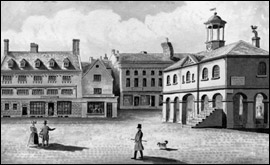 | The (former) Town Hall, Banbury, c1800
Copyright Oxfordshire County Council Photographic Archive |
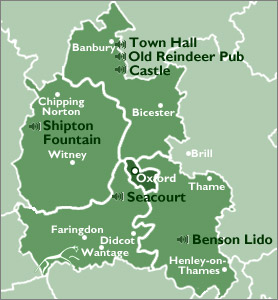
| | On this page you can listen and read about some amazing stories from Oxfordshire. You can find out more unusal stories from the county town in on the secret Oxford page here. |
| | | 
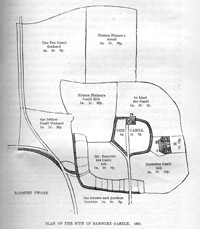
Secret Oxford >>> | Castle - Banbury | | Plan of the site of Banbury Castle, 1685
Copyright Oxfordshire County Council Photographic Archive | The excavations that took place before the construction of Banbury's new shopping centre "Castle Quays" revealed a remarkable fact - that this historic town had had not just one castle but a succession of castles. This major dig revealed the very first castle - a Saxon Manor House constucted from wood and an impressive stone castle built for Alexander the Magnificent who was the Bishop of Lincoln with Banbury in his patch. You might have thought that "new towns" began with Welling Garden City but these excavations give Banbury the chance to claim that it was the site of a 12th century new town. |  Hear BBC Oxford's Mark Young explain more ... Hear BBC Oxford's Mark Young explain more ... |
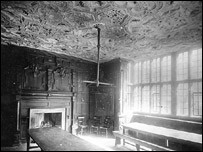
| Globe - Banbury | | The Reindeer Inn, the Globe Room, c1889
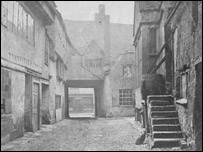
Copyright Oxfordshire County Council Photographic Archive | A 1912 edition of the Banbury Guardian claimed that the Globe Room had disappeared and had been seen in the United States. The Globe Room which forms part of Banbury's Ye Olde Reindeer Pub is a superb panelled room dating from the 16th century which witnessed several trials of Royalists during the English Civil War. Find out how the room was found in the 1960's in London and now has been restored to its original Banbury home. | | The Reindeer Inn, courtyard, c1885
Copyright Oxfordshire County Council Photographic Archive | | Hear BBC Oxford's Mark Young explain more ... |
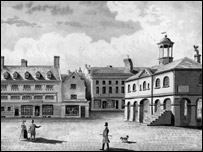
| Townhall - Banbury | | The (former) Town Hall, Banbury, c1800
Copyright Oxfordshire County Council Photographic Archive | Few people know that Banbury's town hall in the 19th century stood at the top of Market Place and was later moved to a site near the town's historic waterway. Hear the remarkable tale of the town's former mayor, Thomas Draper, who loved the first town hall so much that he had it dismantled brick by brick and reconstructed in the canal zone. The canal zone was also home to Banbury's legendary 19th century beer houses which quenched the thirst of its hard working population. The Golden Lion, constucted in 1860, was one of the best known beer houses which sadly closed in the 1960's. | | Hear BBC Oxford's Mark Young explain more ... |
| Shipton Fountain |  | Fountain on the green, Shipton-u-Wychwood, 31.1.1974
Copyright Oxfordshire County Council Photographic Archive |
The charming village of Shipton under Wychwood is home to a fountain which commemorates one of Britain's worst maritime disasters. The monument was erected in 1878 to remember the 17 villagers from Shipton who lost their lives on their way to a new life in New Zealand. The good ship Cospatrick was an emigrant ship working for the New Zealand Government. It caught fire off Tristan da Cunha and only 3 crew members survived with 477 passengers losing their lives to fire and the sea. The national press of the time claimed that the survivors drank the blood of and ate the livers of the dead as they drifted for weeks. The captain, Alexander Elmslie remained on the ship before finally jumping overboard and drowning. Two full rescue boats were launched but only one was eventually found by the British ship - the Sceptre. Charles Macdonald, Thomas Lewis and James Cotter were the only survivors. The 17 villagers from Shipton were hoping to escape the poverty of being an agricultural worker by finding a new life. They all came from two families - the Townsends and the Hedges. In 1974 a beech tree was planted in Shipton under Wychwood to commemorate 100 years since the sinking. | | Hear BBC Oxford's Mark Young explain more ... |
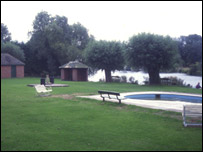
| Benson Lido | | In 1937 RAF Benson began to expand - anticipating aggression from a Germany ruled by the Nazi Party. By 1939 the 150th Squadron had moved in and within two years, this historic village was also home to the new Photographical Reconnaissance Unit. 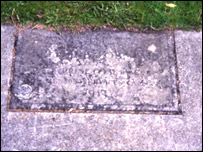
Throughout the war the servicemen had exclusive use of a lido run by a Mr Young, of which only a lichen incrusted plaque remains. | | Hear BBC Oxford's Mark Young explain more ... |
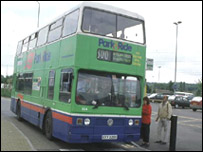
| Seacourt | | | Six hundred years ago the prosperous village of Seacourt was the ideal stopping point for pilgrims on their way to St Margaret's Well at Binsey. The lost village of Seacourt, which was situated just off the Botley Road, lay at the Western End of Oxford close to the old Berkshire and Oxfordshire border. It took its name from the church of Seckworth - hence Seacourt. Today this former "lost village" lies under pasture on the eastern end of Wytham Hill and on the Berkshire bank of Seacourt stream which marked the county boundary. Evidence that the village ever existed emerged in the summer of 1939 when Oxford archaeologists took advantage of the proposed western bypass to begin excavations. Later excavations were able to pinpoint the exact site but the reasons for the demise of this once busy stop off point, which left the village which only two residents in 1439, are not clear. Flooding and the Black Death are considered to be the two key factors. Discover how Oxford's well known "Park and Ride" takes its name from this "lost village". | | Hear BBC Oxford's Mark Young explain more ... | | Check out our photo galleryof the Canal Basin. |
Secret Oxford >>> BBC download guide : Free Real player If you know any interesting or unusual stories about Oxfordshire then we want to know about it. Email your story here. | | | |
|
|