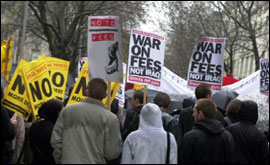
Charles Clarke, Education Minister, believes that a graduate tax rather than top-up fees would be the fairest way to solve the university funding crisis.
Last week he admitted that students face leaving university with debts of up to £21,000 as a result of higher tuition fees. What is a graduate tax? Students would have to pay up to 3p in the pound after graduating to pay back the cost of their higher education. The tax would not kick-in until a threshold salary had been reached, thought to be around £30,000. What are top-up fees?  In most respects, the law treats 18-year-olds as independent. In most respects, the law treats 18-year-olds as independent.
The exceptions are higher education, driving a heavy lorry or having an air weapon in a public place. They can vote, pay taxes, drive a car, get married without parental permission and borrow money.  | | Charles Clarke, Education Secretary |
The government is planning to radically restructure the funding of higher education by introducing top-up fees or a graduate tax. Top-up fees would be set by the universities individually and the £1,100 university tuition would be abolished. Forcing through top-up fees
Tony Blair appears ready to force through top-up fees for universities, and is also prepared to combine it with some form of repayment after graduation, known as the graduate tax. One favoured option is the Australian systen - Higher Education Contribution Scheme - where students are given a choice of paying during or after their course. One of Charles Clarke's "first principles is that people from low incomes will not be deterred from going to university, if they have the talent." But will this be possible? Click here to have your say and see what others have said. |