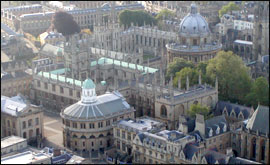
The Holywell Music Room, built in 1748, is the oldest music performance hall in Europe. Oxford University is the oldest English-speaking university in the world. Do you have a fascinating Oxfordshire fact you can add to this page? Send us an e-mail |
Oxfordshire is home to the Rollright Stones, a 4,500-year-old stone circle and burial chamber considered one of the most important Neolithic sites in Britain. The Ridgeway is the considered to be the oldest road in Europe - 5,000 years old. The White Horse of Uffington is thought to be the oldest hill figure in Britain. It is 374 feet long and thought to date back 12,000 years, to the late Bronze Age. Abingdon is claimed to be the oldest-continuously occupied settlement in Britain. It's not the oldest town, because it hasn't always been a town. Tooley's Boatyard in Banbury has the oldest working dry-dock in the country, dating back more than 200 years. Writer Tom Rolt had a boat restored there before setting off on a voyage that led to the revival of England's canal system. Oxford graduate Tim Berners-Lee is blamed for inventing the Internet. Oxfam, the Oxford Committee for Famine, was founded in Oxford in 1942. Most of the traditional hanky-waving morris dances now performed around the English-speaking world were "collected" in Oxfordshire. Each dance was unique to a town or village.
Oxfords Ashmolean Museum, officially opened in 1683, was the first museum in the world to be opened to the public - 70 years earlier than the British Museum. The Ashmolean has the lantern Guy Fawkes used in his attempt to blow up the Houses of Parliament (he failed). The Museum of the History of Science in Broad Street is said to be the first purpose-built museum in the world. If the thought of a museum makes your head shrink, get along to the Pitt Rivers Museum in Oxford - it has several shrunken heads already. Oxford was and is home to the creators of Alice in Wonderland, The Lord of the Rings, The Chronicles of Narnia, Inspector Morse and the His Dark Materials trilogy - which actually features several parallel Oxfords, linked by a slit in the fabric of the universe at Summertown. Oxford has more published writers per square mile than anywhere else in the world. Take care not to trip over one. Books have been printed in Oxford since 1478. The Oxford English Dictionary was born in... Oxford! (Seriously, it says this in the City of Culture bid). Tom Brown's Schooldays was written in Uffington - and the school is still in use, as the village museum. Poet laureate John Betjeman also lived in Uffington, but much, much later. Banbury was a centre for the printing of chapbooks cheaply produced stories for children. The saying, "Red sky at night, shepherd's delight," was popularised in a Banbury chapbook. There are several versions of the famous Banbury Cross nursery rhyme. One goes: Ride a cock horse to Banbury Cross
To see an old woman get up on a horse
A ring on her finger, a bonnet of straw
The strangest old woman that ever you saw. In 1954, Roger Bannister became the first person to run a mile in less than four minutes, at Oxfords Iffley Road sports ground. Oxfordshire is home to the Bennetton Formula One racing team and many Formula One cars are built in the county People at Henley are quite keen on rowing. The annual regatta was first held in 1839. Bicester Hash House Harriers are the oldest weekly hash in the UK. Hashing involves running around the countryside looking for blobs of flour. At the end, miscreants are required to down a pint of beer. It's surprising it's not more popular. Punting is actually a sport - racing punts are only about 15 inches wide and are poled by two people, one at either end. The important thing is to remember which one is in front, or the punt goes round in circles. Only in Oxfordshire are you likely to see anyone playing Aunt Sally... a pub game that involves throwing sticks at a blob of wood. A lot of people take this very seriously. The world cockhorse-racing championships are held every summer as part of Town Mayor's Sunday in Banbury. Each horse is ridden by a team of four adults, with a casualty rate similar to the Grand National. Oxford has more than 1,500 listed buildings, including Gibbs Radcliffe Camera, Wrens Sheldonian Theatre, and Hawksmoors All Souls. Blenheim is a World Heritage Site - a claim that Oxford can't yet make, strangely. Banbury Cross is not the one in the famous nursery rhyme. That one was knocked down by Puritans in July 1600. Whoops. Alfred the Great was born in Wantage, where he did not learn to bake cakes. In 1154, Nicholas Brakespear, former rector of Binsey, became Hadrian IV, Englands only pope. Artist William Morris, leading light of the Arts & Crafts Movement, lived at Kelmscott Manor in west Oxfordshire. His stained glass can be seen in a number of churches round the county. Sir Winston Churchill is buried at Bladon, near Woodstock. His ancester, the 1st Duke of Marlborough, lived at Blenheim and was long regarded as England's greatest military leader. During the English Civil War, Oxford was Charles Is capital. The Parliamentarians made battle plans at Broughton Castle and the Olde Reindeer pub in Banbury. The Oxford Union was described by former prime minister Harold MacMillan as "one of the last bastions of freedom of speech in the Western World". It was founded in 1823 and its officers have included five UK prime ministers - MacMillan, Gladstone, Lord Salisbury, Asquith and Heath. Pakistan's one-time premier, Benazir Bhutto, was union president in 1977. But debates are closed to Joe Public, so it's not much help to the City of Culture bid. The Bear Inn claims to be the oldest pub in Oxford, dating back to 1242. It has a tremendous collection of snipped-off ties. Bereaved owners are given a free pint. Oliver Cromwell planned the Battle of Edgehill in the fine wood-panelled Globe Room at the Olde Reindeer pub in Banbury. The panelling was sold by the Hook Norton Brewery in 1912 but rediscovered in a London warehouse and finally restored to the pub in 1981. The Falkland Arms at Great Tew still sells its own clay pipes and snuff (not to be used together). Oxfordshire is the only county in England with three Areas of Outstanding Natural Beauty the North Wessex Downs, the Cotswolds and the Chilterns. Banbury cattle market was known as The Stockyard of Europe in its heyday, but it closed in 1998. A monthly farmers' market continues a centuries-old tradition of agricultural trade in the town. The C S Lewis Nature Reserve at Headington is the woodland that inspired the forests in The Chronicles of Narnia and Tolkien's Middle Earth. Abingdon has two mayors. No, really - there's the council's mayor, and there's the Mayor of Ock Street, probably the most significant survivor of England's mock-mayors tradition. He is elected by people who live and work in Ock Street and every June in "chaired" between the many pubs in the road (most now closed, along with the brewery). |