
Home > Opinion > It's less tragic when disabled people die
Lucy Sholl

Biographical details to follow.
It's less tragic when disabled people die
31st March 2005
 A close family friend died back in January. It was surreal, as sudden deaths always are. Ten days before, he'd spent Christmas Day with us, banging out show tunes on the piano while the rest of us warbled along.
 You always feel like protesting "but he can't be dead, I only saw him a week ago", as if by simply having seen someone recently you ensure their continuing existence. He was 58, and his friends and family felt cheated by his early, unexpected death.
Although the last year has been quite heavy on death for me, his was the first to merit media coverage (though I won't be mentioning his name in this article). His job meant that he was well-known enough for obituaries to start appearing less than 24 hours after he died, and I went around collecting the newspapers and cutting out all the articles. I enjoyed reading them and it gave my sadness a sort of focus. Most were interesting and affectionate, but I started to feel frustrated by their tone ...
Our friend had developed Parkinson's in the last few years of his life, but died of an apparently random pulmonary embolism. Although everyone knew that his Parkinson's would progress and he would gradually become less and less mobile, this was a process which was expected to take decades.
To me, and most people who knew him, his was a tragically early death, and his Parkinson's was neither here nor there. But the majority of the obituaries talked about an old man who had reached the natural end of a long life. One simply said he that he had "died after a long illness", clearly implying that his death had been a result of the slow deterioration due to Parkinson's. He was 58, not 25, but I still expected the death of someone in their fifties to be seen as particularly sad - and early.
Up until his death he had carried on writing books, broadcasting, even plotting to infiltrate a local literary festival with a one-man musical comedy skit about Parkinson's. He was one of the most energetic people I knew. The highlight of my Christmas was a staggering rendition of the little-known music hall classic Tits and Arse, performed by him and his daughter.
He was a fantastic disability ally for me. When we met up at parties we'd sit in the Cripple's Corner together (our joke, you understand, not an officially designated area). Thanks to his presence, this always ceased to be the black hole of the party and guaranteed me a steady stream of guests to monopolise as they queued to speak to him.
As far as I was concerned, this was a man in the full swing of life, not someone waiting to die.
Although the last year has been quite heavy on death for me, his was the first to merit media coverage (though I won't be mentioning his name in this article). His job meant that he was well-known enough for obituaries to start appearing less than 24 hours after he died, and I went around collecting the newspapers and cutting out all the articles. I enjoyed reading them and it gave my sadness a sort of focus. Most were interesting and affectionate, but I started to feel frustrated by their tone ...
Our friend had developed Parkinson's in the last few years of his life, but died of an apparently random pulmonary embolism. Although everyone knew that his Parkinson's would progress and he would gradually become less and less mobile, this was a process which was expected to take decades.
To me, and most people who knew him, his was a tragically early death, and his Parkinson's was neither here nor there. But the majority of the obituaries talked about an old man who had reached the natural end of a long life. One simply said he that he had "died after a long illness", clearly implying that his death had been a result of the slow deterioration due to Parkinson's. He was 58, not 25, but I still expected the death of someone in their fifties to be seen as particularly sad - and early.
Up until his death he had carried on writing books, broadcasting, even plotting to infiltrate a local literary festival with a one-man musical comedy skit about Parkinson's. He was one of the most energetic people I knew. The highlight of my Christmas was a staggering rendition of the little-known music hall classic Tits and Arse, performed by him and his daughter.
He was a fantastic disability ally for me. When we met up at parties we'd sit in the Cripple's Corner together (our joke, you understand, not an officially designated area). Thanks to his presence, this always ceased to be the black hole of the party and guaranteed me a steady stream of guests to monopolise as they queued to speak to him.
As far as I was concerned, this was a man in the full swing of life, not someone waiting to die.
The funeral was a good redress. The people who talked in the service left no doubt that his life had been cut short prematurely in middle age. And most people I spoke to afterwards thought similarly. But I did hear a few comments along the lines of "a blessed release". Plus, of course, there were all the usual funeral platitudes about how we should be celebrating his life rather than mourning his death.
I always have a problem with that sort of comment. As far as I'm concerned, death is sad and whoever has died surely deserves some wailing and breast-beating. If we're not allowed to feel sorry for ourselves and the person we've lost at the funeral, then when are we?
Anyone who has lost somebody knows that a succession of stock phrases are always trotted out, and if you've tried to comfort a bereaved friend or relative you'll know how hard it is to avoid those clichés and work out what the hell to say. But when the person who has died was disabled or ill, there's a whole other list to choose from: "at least you won't have to watch them deteriorate", "they're not in pain anymore", "well, it's really a blessed release ..."
I can't be the only disabled person who finds this hard, and silently applies it to themselves. I mean, I'm in pain, but that doesn't mean I want to be 'released' from it - not through death, anyway.
Sometimes, of course, the clichés are true. When my mother died, it was at the end of a period of intense, indescribable pain and suffering that left people at a loss as to how to react. In an extreme situation like that, it's understandable for people to take refuge more than ever in the clichés. And in a way, in the case of my mother, it was all true - she had been released from her suffering, and she wasn't in pain anymore. But I still couldn't find comfort in such phrases.
I couldn't find comfort in knowing her suffering was over. If anything I felt doubly sad that she had had to endure so much and, on top of that, die at the age of only 49, before she'd seen all her children grow up.
But what is frustrating is that these phrases have nothing to do with the individual, how disabled they were, how much they were suffering, or if they wanted it all to end. It seems as though once the label 'disabled' is stuck on you, whatever your condition, the world puts you into some middle ground - a holding station between life and death - from which you're just waiting to be released into the next stage. Whether intended or not, what comes across is that the death of someone disabled is always less tragic than the death of someone able-bodied.
But do they really believe what they're saying? Or are they trying to make death seem less frightening, less threatening and more distant for themselves?
Whenever someone we know dies, it demonstrates to us that it does actually happen: we'll all die one day, and the secret feeling we hold on to that it'll never really happen to us is temporarily blown away. So maybe we try to reassure ourselves by putting the deceased in a different category from us. They were old: old people die. They were disabled: disabled people die. However, I am neither of the above. Phew!
Or perhaps I'm being unfair. Death is horrible and irrational, and when someone dies no one knows how to react. We all try to rationalise it in any way we can, in order to cope with the sadness. We try to see it as a life completed rather than a life cut short, so that it makes sense to us and we're not left thinking "What if?".
When a child dies they become a symbol of innocence - forever young, forever perfect. When an old person dies we reassure ourselves that it was 'a life well lived' and that they had 'a good innings'.
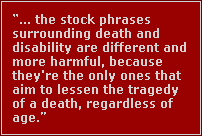
Yet the stock phrases surrounding death and disability are different and more harmful, because they're the only ones that aim to lessen the tragedy of a death, regardless of age.
I can't claim that I'm able to be objective about this. All death-related clichés are bland and useless in the face of real grief, and they all seem hollow when it concerns your child, mother, friend or grandmother. But I'll continue to feel that the disability ones are the most destructive until I'm proved wrong. Whatever the circumstances, we should think a bit more carefully before reeling out the clichés, and stop to consider if they're really appropriate, and if we really mean them.
I always have a problem with that sort of comment. As far as I'm concerned, death is sad and whoever has died surely deserves some wailing and breast-beating. If we're not allowed to feel sorry for ourselves and the person we've lost at the funeral, then when are we?
Anyone who has lost somebody knows that a succession of stock phrases are always trotted out, and if you've tried to comfort a bereaved friend or relative you'll know how hard it is to avoid those clichés and work out what the hell to say. But when the person who has died was disabled or ill, there's a whole other list to choose from: "at least you won't have to watch them deteriorate", "they're not in pain anymore", "well, it's really a blessed release ..."
I can't be the only disabled person who finds this hard, and silently applies it to themselves. I mean, I'm in pain, but that doesn't mean I want to be 'released' from it - not through death, anyway.
Sometimes, of course, the clichés are true. When my mother died, it was at the end of a period of intense, indescribable pain and suffering that left people at a loss as to how to react. In an extreme situation like that, it's understandable for people to take refuge more than ever in the clichés. And in a way, in the case of my mother, it was all true - she had been released from her suffering, and she wasn't in pain anymore. But I still couldn't find comfort in such phrases.
I couldn't find comfort in knowing her suffering was over. If anything I felt doubly sad that she had had to endure so much and, on top of that, die at the age of only 49, before she'd seen all her children grow up.
But what is frustrating is that these phrases have nothing to do with the individual, how disabled they were, how much they were suffering, or if they wanted it all to end. It seems as though once the label 'disabled' is stuck on you, whatever your condition, the world puts you into some middle ground - a holding station between life and death - from which you're just waiting to be released into the next stage. Whether intended or not, what comes across is that the death of someone disabled is always less tragic than the death of someone able-bodied.
But do they really believe what they're saying? Or are they trying to make death seem less frightening, less threatening and more distant for themselves?
Whenever someone we know dies, it demonstrates to us that it does actually happen: we'll all die one day, and the secret feeling we hold on to that it'll never really happen to us is temporarily blown away. So maybe we try to reassure ourselves by putting the deceased in a different category from us. They were old: old people die. They were disabled: disabled people die. However, I am neither of the above. Phew!
Or perhaps I'm being unfair. Death is horrible and irrational, and when someone dies no one knows how to react. We all try to rationalise it in any way we can, in order to cope with the sadness. We try to see it as a life completed rather than a life cut short, so that it makes sense to us and we're not left thinking "What if?".
When a child dies they become a symbol of innocence - forever young, forever perfect. When an old person dies we reassure ourselves that it was 'a life well lived' and that they had 'a good innings'.
Yet the stock phrases surrounding death and disability are different and more harmful, because they're the only ones that aim to lessen the tragedy of a death, regardless of age.
I can't claim that I'm able to be objective about this. All death-related clichés are bland and useless in the face of real grief, and they all seem hollow when it concerns your child, mother, friend or grandmother. But I'll continue to feel that the disability ones are the most destructive until I'm proved wrong. Whatever the circumstances, we should think a bit more carefully before reeling out the clichés, and stop to consider if they're really appropriate, and if we really mean them.
Bookmark with...
Live community panel
Our blog is the main place to go for all things Ouch! Find info, comment, articles and great disability content on the web via us.
Listen to our regular razor sharp talk show online, or subscribe to it as a podcast. Spread the word: it's where disability and reality almost collide.
More from the BBC

All the latest news from the paralympics.

News and views for people who are blind or partially sighted.

Weekdays 12.40pm. Radio 4's consumer affairs programme.

~RS~q~RS~_bbc_=0&__ip__=54.77.33.255&dnainitialtitle=It%27s%20less%20tragic%20when%20disabled%20people%20die&dnahostpageurl=http://www.bbc.co.uk/ouch/opinion/its_less_tragic_when_disabled_people_die.shtml&dnauid=ouch:article:1074&s_baseHeadingLevel=1&dnashow=10&dnafrom=0&dnato=9&dna_encoding=utf-8&s_sssicomponent=1&s_sssiCommentCount=&dnacommentforumlistprefix=%5B_%5D&dnarecentcommentsprefix=%5B_%5D&s_commentprofileurl=/dna/mbouch/CommentProfile?&s_contact=0~RS~z~RS~47~RS~)

Comments