
Home > Opinion > Face to Facebook
Kaliya Franklin

So desperate was she to live a life of state subsidised ease that Kaliya actually altered her own DNA, making her connective tissue so lax that she can dislocate body parts she can’t even name. Using the nom de plume Bendy Girl, she blogs at Benefit Scrounging Scum about the reality of life lived as the kind of benefit claimant the tabloid press doesn’t know exists.
Face to Facebook
12th May 2009
Social networking websites have revolutionised how we keep in touch with friends, know who our 'friends' are and even what friendship means. Disabled in her late 20s, Kaliya Franklin has a love hate relationship with the big site that everyone seems to be a part of.
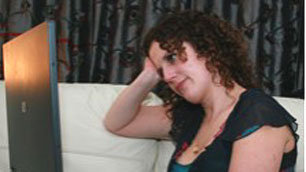
Recently, I bumped into an old friend whom I've not seen for more years than I'm prepared to admit. We chatted for ages about anything and everything. Well, everything except my snazzy purple wheelchair ... which I didn't need the last time I saw her. A conversation opener if ever there was one.
Like many bendy people, my diagnosis of Ehlers Danlos Syndrome came later in life, before which I was classed as an attention seeker, not disabled. As she didn't mention my wheelchair, I assumed my friend must be that rare and wonderful creature who accepts others without question. Until I got home, logged in to my Facebook account and saw the message she'd sent wanting to know about my disability. It seems she was more curious than accepting, but couldn't bring herself to ask me in person.
The way in which Facebook lets you keep all your pals in one place makes your social life easy to manage. But for many people, Facebook's biggest attraction is the ease in which friends who've lost contact can rediscover each other. That may seem great, but if you have acquired your disabilities or become disabled later in life, it can mean you find yourself having to explain your situation more frequently.
Online, you can choose to keep disability secret, but if you keep schtum you have to remember to edit out all disability stuff from future conversations, which can lead to a total re-working of your life. But if you choose to be 'out' with your rediscovered pal, a painful full-blown conversation needs to happen. They knew you of old, and they feel they have a right to ask for a full list of events that turned you into the new you.
Like many bendy people, my diagnosis of Ehlers Danlos Syndrome came later in life, before which I was classed as an attention seeker, not disabled. As she didn't mention my wheelchair, I assumed my friend must be that rare and wonderful creature who accepts others without question. Until I got home, logged in to my Facebook account and saw the message she'd sent wanting to know about my disability. It seems she was more curious than accepting, but couldn't bring herself to ask me in person.
The way in which Facebook lets you keep all your pals in one place makes your social life easy to manage. But for many people, Facebook's biggest attraction is the ease in which friends who've lost contact can rediscover each other. That may seem great, but if you have acquired your disabilities or become disabled later in life, it can mean you find yourself having to explain your situation more frequently.
Online, you can choose to keep disability secret, but if you keep schtum you have to remember to edit out all disability stuff from future conversations, which can lead to a total re-working of your life. But if you choose to be 'out' with your rediscovered pal, a painful full-blown conversation needs to happen. They knew you of old, and they feel they have a right to ask for a full list of events that turned you into the new you.

As we know only too well, the "I'm disabled now" conversation can become long and involved, and it's usually the other person who is more sensitive, confused and tearful. The idea of it makes my heart sink. And to be frank, I don't want to think about anything real when there are dead sheep to be thrown at my mates or poke wars to be started.
I have created a standard explanation to send to anyone who asks, but many people have more questions than that. Most difficult to cope with are old school friends who tell me they thought I was putting it on when I couldn't be bothered to do something, or that they didn't realise I was ill because I "really, really don't look it". Explaining that many disabilities are invisible and that I'm disabled, not ill, just complicates the matter. The subtext seems to be "are you sure you're not still making it up?" After all, life on benefits is a tax payer subsidised idyll, and who wouldn't want to invent a disability to avoid work?

I'm now so determined to avoid this 'Facebook feeling' that I've still not replied to friends who added me to their networks over a year ago. The irony is that in my 'real world' life, I prefer people to ask me questions about why I use wrist braces or a wheelchair, rather than remaining awkwardly silent or making things up for themselves. I like to have some control of how people think about me and why I'm disabled - unless they've imagined up wild tales about crocodile wrestling, which could be fun. But online, people dig deeper and say things they'd never say directly to your face. Online they can hide behind their keyboard.
When I'm going through a bad patch, it can really help to be able to use sites like Facebook to escape into an online virtual world. While there, these very personal questions about my disability can feel like a huge burden. The responsibility of having to spare other people's feelings and provide the reassurance they need to hear is too much when I want to just scream, "No there is no cure, treatment or exorcism. It is what it is and if you can't handle that, it's your problem!"
When I'm going through a bad patch, it can really help to be able to use sites like Facebook to escape into an online virtual world. While there, these very personal questions about my disability can feel like a huge burden. The responsibility of having to spare other people's feelings and provide the reassurance they need to hear is too much when I want to just scream, "No there is no cure, treatment or exorcism. It is what it is and if you can't handle that, it's your problem!"

Still, love it, hate it, or want to wrap it in tinfoil, Facebook can only reflect the lives of those who use it. Disabled people are far more present online than in the street or the workplace so, when conversations start, they're unrehearsed and people don't have the right language or etiquette to deal with it on the virtual walls and personal messaging provided.
But perhaps this is a way of making disability more acceptable. First via online discussions, then leaking into proper offline life. So in 15 years from now, no disabled person will be able to recognise the 'Facebook feeling' because we'll all be a bigger part of the landscape and less remarkable.
But perhaps this is a way of making disability more acceptable. First via online discussions, then leaking into proper offline life. So in 15 years from now, no disabled person will be able to recognise the 'Facebook feeling' because we'll all be a bigger part of the landscape and less remarkable.
• Kaliya Franklin blogs about "life, love and attempts to make sense of the nonsensical" at Benefit Scrounging Scum.
More articles about
Bookmark with...
Live community panel
Our blog is the main place to go for all things Ouch! Find info, comment, articles and great disability content on the web via us.
Listen to our regular razor sharp talk show online, or subscribe to it as a podcast. Spread the word: it's where disability and reality almost collide.
More from the BBC

All the latest news from the paralympics.

News and views for people who are blind or partially sighted.

Weekdays 12.40pm. Radio 4's consumer affairs programme.

~RS~q~RS~_bbc_=0&__ip__=54.76.44.195&dnainitialtitle=Face%20to%20Facebook&dnahostpageurl=http://www-sis.bbc.net.uk/ouch/opinion/face_to_facebook.shtml&dnauid=ouch:article:2015&s_baseHeadingLevel=1&dnashow=10&dnafrom=0&dnato=9&dna_encoding=utf-8&s_sssicomponent=1&s_sssiCommentCount=&dnacommentforumlistprefix=%5B_%5D&dnarecentcommentsprefix=%5B_%5D&s_commentprofileurl=/dna/mbouch/CommentProfile?&s_contact=0~RS~z~RS~27~RS~)
