
Home > Interviews > Audio: Alastair Campbell
Audio: Alastair Campbell
30th March 2011
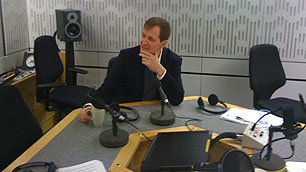
Nineteen year old Hannah grills former Downing Street press secretary Alastair Campbell.
They chat about job choices, getting back to work after a period of depression and the importance of openness when it comes to mental health.
Originally part of the Ouch Talk Show, the interview features Liz Carr and some unscripted questions from 15 year old George.
They chat about job choices, getting back to work after a period of depression and the importance of openness when it comes to mental health.
Originally part of the Ouch Talk Show, the interview features Liz Carr and some unscripted questions from 15 year old George.
In order to see this content you need to have both Javascript enabled and Flash installed. Visit BBC Webwise for full instructions
[+] Click to reveal transcript
LIZ Alastair Campbell is with us now. Thank you, Alastair, for coming in.
ALASTAIR Pleasure.
LIZ Alastair Campbell, Tony Blair's former press secretary, former journalist, novelist, broadcaster, strategist, family man - well we've got you in today by the request of Hannah, she's helping edit our show and Hannah, why did you want to meet Alastair?
HANNAH I wanted to meet Alastair because for a while I've known about him having mental health problems. As a young person who has mental health problems myself, I'm always interested to observe and speak to older people who've also been very successful in their careers to see how they've managed, the issues they've faced, kind of to get information from them in a way to help me as I'm quite career driven. And also to, hopefully, inform people who don't know that much about mental health that it is possible to be successful and to live a 'normal' life whilst still having this kind of disability.
LIZ So what's your first question for Alastair?
HANNAH My first question is that you've described yourself as an obsessive and your partner says that you worked seven days a week, 24 hours a day when you were at Downing Street, so do you think your career path has been the healthiest choice for you or...?
ALASTAIR No I don't think... and also not just my political career path my journalism career path wasn't very healthy either. In fact I think I got...
GEORGE Very stressful?
ALASTAIR What?
GEORGE Very stressful
ALASTAIR Well it was also I drank too much and I think that was when I realised that I had a problem when I was... I loved being a journalist I really loved it, I was full on the whole time, but I got into... developed a drink problem, then had a breakdown, and it was coming out of the breakdown I think that I realised that a lot of the stuff that I'd had in my head before, which I'd never really identified I'd just kind of lived with it and probably drank and worked in part to sort of keep it at bay, was probably what I now define as having depression.
But it's interesting what you said in your introduction because when I had my breakdown I found that I was interested in other people who'd been through similar experiences and kind of lived to tell the tale. I mean you do know of people who don't live to tell the tale and you know people who really are in a bad way for the rest of their lives, and of course, you know, some people decide to take their own lives. But I think it is important that the more open we are about our own issues and problems then the more we can hopefully help other people who are struggling with the same things. And often it's the feeling of solitude and the feeling of loneliness and the feeling that you can't... you think you're the only person who's kind of got these problems that I think sometimes exacerbates them. So I think the more we're open about it the better.
HANNAH Would you say your career choice contributed to your breakdown?
ALASTAIR I don't know but I think it probably did yeah. But I don't regret that. I'm glad that I went into journalism, I enjoy being a journalist. This will sound really odd, but I'm also glad that I had a breakdown because I used it in a way, I was very lucky, Fiona my partner stayed with me which I think a lot of women wouldn't have done, to be frank. We had our first child a year later. I stopped drinking. I'd worked out who my friends were which was important. And so I learnt a lot from it. And I think the other thing is I didn't have a choice about being open because when it happened it was 1986, I jumped onto the political side of the fence in 1994 and of course the press knew about it. Now when I was back being a journalist it wasn't very interesting. Suddenly I was Tony Blair's 'right hand man' and it was interesting and so they started to write about it and I thought, "Sod it I'll just be very open about it" and I've never regretted that. I hated the breakdown at the time but I actually now look back on it as one of the best things that ever happened to me.
HANNAH I completely agree, that's exactly the way I see my health problems as well. So in 1986 you, as you said, you took time off work after having your breakdown how did you find getting back into work, was it easy, did you find that people treated you differently, did you experience any prejudice or anything like that?
ALASTAIR I never felt prejudice but I felt it wasn't easy. I had several months off and then I went back to my old paper, The Mirror I'd left The Mirror to go Today and I went back to The Mirror so I felt comfortable and I liked the people there but I felt very, very edgy for quite a long time. In fact the very first story I was sent on it couldn't have been a worse story to go on, it was a terrorist incident at Heathrow, and on the day of my breakdown I'd been through Heathrow because I'd flown up to Scotland, and I mean it's too long and complicated a story to tell now but there was a terrorist thing going on then as well, so I was very, very on edge. I ended up phoning colleagues of mine on The Mirror one of whom worked in Plymouth, one of whom worked in Bristol and I ended up getting them to help me do the story. I basically did it from a phone box at Heathrow because I was really on edge. And it took me a while to get back into the rhythm of it.
I'll tell you what I did find difficult was that some of my colleagues, and I don't blame them for this because I think you want people to be like you sometimes I think, and I was trying very, very hard not to drink, it was a very drinking culture and quite a few of them would say, "Come on you can have one" and that sort of thing was quite difficult. But once they all accepted that, you know, I really had to kind of see this thing through they were fine and actually very helpful and very supportive.
HANNAH That's great, that's really good. So many young people suffer from mental health problems I think it's one in ten young person will suffer from a mental health problem, and then it goes up to one in four as an adult. So what advice would you give to a young person to maintain, not only like kind of preserve their mental wellbeing, but as a preventative measure as well as a response, so how would you, someone who's been suffering from mental health problems, especially a young person, what would you say to them as advice?
ALASTAIR I think it's very hard because everybody's an individual, but I think in general terms all I can do is say what I've found has helped me and what I've learnt from other people's experience that I know. For me, for example, exercise is incredibly important, that feeling of physical fitness I think is very much tied up with my sense of mental wellbeing. And I think the other thing that, as I said to you earlier, I almost stumbled across this as a strategy but I have found openness very, very helpful. And I don't just mean openness in coming on in front of a microphone and talking to you like this, I mean openness generally; I mean actually being able to say to people like you'd say if you'd... you know, you're walking around on crutches and somebody says, "Oh what have you done?" And you say, "I broke my leg, I fell of my bike" "I was playing football" whatever I think to be open and to feel that you're able to say, "Look, you may not understand this but actually I've got this stuff goes on in my head and it's difficult to deal with but it's just kind of part of who I am." And I think if we could all take that attitude both those who have the problems and those who are trying to deal with them... Because I'll tell the thing, I don't know what your experience is like with your family, I think families are... it's where you go for the most support but it's also often where you find the most pressure because they really, really want you to be, to use your word earlier, 'normal'. And when I get very, very badly depressed, I mean I know this and I hate myself for it, but you do feel... I find myself taking it out on Fiona, my partner, because she's the only one that I feel I can completely let go with. Whereas with my children I always probably try to hide it a little bit. But actually with them now I tend to be very, very open. I say to them, "Look, you know, I'm going through a bad patch" and they know or they have experience of me going through that and then coming out of it.
And I think that sense of involving them, maybe this is selfish I don't know, but I feel the sense of involving other people in your strategies for dealing with it is important. And also get help if it's there. So many people either feel ashamed or they feel isolated or they feel that nobody else is going to understand and actually if you go out and talk to most people they will understand, they will have an understanding even if they've never had direct experience of it.
LIZ It's important isn't it to get the right support definitely.
HANNAH Yeah.
LIZ Can I take this opportunity, I hope you don't mind?
HANNAH No.
LIZ And just I have to ask you what do you make of the cuts to disability benefits and the current benefit reform really?
ALASTAIR Well I think even accepting that the Government has to make some difficult decisions, and I think I do, I'm afraid I think they are going far too fast and dangerously in too many areas and without regard to the consequences for individuals. Now sometimes that's just what it's like in government you have a overall economic strategy, so their strategy is to get the deficit under control, and that's going to require some tax rises and a lot of public spending cuts. But I think that these cuts are so deep and so difficult that they are going to have to face the consequences that they're going to affect people really, really badly.
Now I don't think I can sit here and say they shouldn't be making any cuts to any benefit at all, or that they shouldn't be reviewing some of the benefits as they exist, but I think in this, as in so many other areas, I think they're doing it from an ideological perspective, they actually don't need to make the cuts in the sector to the degree that they do. The deficit up to the financial crash was manageable, they've just decided to use the economic crash as an ideological cover to bring about the kind of small state vision that they've always believed in.
LIZ Do you think they're going to have an impact on disabled people, on people with mental health problems?
ALASTAIR To be fair, Nick Clegg when he spoke about mental health issues recently he said a lot of the right things. However, the right things then have to be translated in terms of policy and a lot of policy in this area it has to be backed up with cash. And whether you like it or not, part of the role of government is to make sure that the most vulnerable are looked after properly. And I worry that with all the other reforms going on in the National Health Service and with all the other cuts agenda that mental health services will go where they've traditionally been which is at the back of the queue when it comes to the demand for funding.
HANNAH I agree actually, I mean, I think, you know, everyone knows politicians that, you know, most of the time they're all talk and not much action.
ALASTAIR Not true, Hannah!
HANNAH Sorry I remain to be convinced and actually...
LIZ And of course that's politicians of ALL parties, Hannah, isn't it?
HANNAH Exactly all parties, none in particular, but I have to say actually before, you know, when the election was going on and all the campaigning I was very much a Tory, I've been a Tory for a long time and now I am not and will not be voting for a long time because I've completely lost faith in all parties. You know, I completely do not agree with what's... I completely agree with what you've been saying, Alastair, about everything.
ALASTAIR Vote Labour then Hannah.
LIZ Now before...
HANNAH I don't think I'd have a roof over my head if that happened.
GEORGE Let's not get into a debate.
LIZ Some unscripted questions at the end, as you'll appreciate, but some good ones, thank you Hannah and George totally, but Alastair thank you so much for joining us...
ALASTAIR Thanks very much indeed.
LIZ ... it's been a pleasure. Alastair's latest book is Diaries Volume 2; Power and the People Two this is the second part of a series of uncut diaries from Alastair's time as press secretary at Downing Street during the Blair years.
ALASTAIR Yeah but the book, I was saying to Hannah, is All In The Mind.
LIZ Fantastic.
ALASTAIR It's about a psychiatrist who has problems.
LIZ And that's your novel?
HANNAH As most do.
ALASTAIR That's my first novel yeah. As most do indeed.
HANNAH Most do yeah.
ALASTAIR Yes. And George I'll send you whatever you want.
GEORGE I'll have whatever, believe me. Do you see yourself as a good author?
LIZ George, come on now!
ALASTAIR Pleasure.
LIZ Alastair Campbell, Tony Blair's former press secretary, former journalist, novelist, broadcaster, strategist, family man - well we've got you in today by the request of Hannah, she's helping edit our show and Hannah, why did you want to meet Alastair?
HANNAH I wanted to meet Alastair because for a while I've known about him having mental health problems. As a young person who has mental health problems myself, I'm always interested to observe and speak to older people who've also been very successful in their careers to see how they've managed, the issues they've faced, kind of to get information from them in a way to help me as I'm quite career driven. And also to, hopefully, inform people who don't know that much about mental health that it is possible to be successful and to live a 'normal' life whilst still having this kind of disability.
LIZ So what's your first question for Alastair?
HANNAH My first question is that you've described yourself as an obsessive and your partner says that you worked seven days a week, 24 hours a day when you were at Downing Street, so do you think your career path has been the healthiest choice for you or...?
ALASTAIR No I don't think... and also not just my political career path my journalism career path wasn't very healthy either. In fact I think I got...
GEORGE Very stressful?
ALASTAIR What?
GEORGE Very stressful
ALASTAIR Well it was also I drank too much and I think that was when I realised that I had a problem when I was... I loved being a journalist I really loved it, I was full on the whole time, but I got into... developed a drink problem, then had a breakdown, and it was coming out of the breakdown I think that I realised that a lot of the stuff that I'd had in my head before, which I'd never really identified I'd just kind of lived with it and probably drank and worked in part to sort of keep it at bay, was probably what I now define as having depression.
But it's interesting what you said in your introduction because when I had my breakdown I found that I was interested in other people who'd been through similar experiences and kind of lived to tell the tale. I mean you do know of people who don't live to tell the tale and you know people who really are in a bad way for the rest of their lives, and of course, you know, some people decide to take their own lives. But I think it is important that the more open we are about our own issues and problems then the more we can hopefully help other people who are struggling with the same things. And often it's the feeling of solitude and the feeling of loneliness and the feeling that you can't... you think you're the only person who's kind of got these problems that I think sometimes exacerbates them. So I think the more we're open about it the better.
HANNAH Would you say your career choice contributed to your breakdown?
ALASTAIR I don't know but I think it probably did yeah. But I don't regret that. I'm glad that I went into journalism, I enjoy being a journalist. This will sound really odd, but I'm also glad that I had a breakdown because I used it in a way, I was very lucky, Fiona my partner stayed with me which I think a lot of women wouldn't have done, to be frank. We had our first child a year later. I stopped drinking. I'd worked out who my friends were which was important. And so I learnt a lot from it. And I think the other thing is I didn't have a choice about being open because when it happened it was 1986, I jumped onto the political side of the fence in 1994 and of course the press knew about it. Now when I was back being a journalist it wasn't very interesting. Suddenly I was Tony Blair's 'right hand man' and it was interesting and so they started to write about it and I thought, "Sod it I'll just be very open about it" and I've never regretted that. I hated the breakdown at the time but I actually now look back on it as one of the best things that ever happened to me.
HANNAH I completely agree, that's exactly the way I see my health problems as well. So in 1986 you, as you said, you took time off work after having your breakdown how did you find getting back into work, was it easy, did you find that people treated you differently, did you experience any prejudice or anything like that?
ALASTAIR I never felt prejudice but I felt it wasn't easy. I had several months off and then I went back to my old paper, The Mirror I'd left The Mirror to go Today and I went back to The Mirror so I felt comfortable and I liked the people there but I felt very, very edgy for quite a long time. In fact the very first story I was sent on it couldn't have been a worse story to go on, it was a terrorist incident at Heathrow, and on the day of my breakdown I'd been through Heathrow because I'd flown up to Scotland, and I mean it's too long and complicated a story to tell now but there was a terrorist thing going on then as well, so I was very, very on edge. I ended up phoning colleagues of mine on The Mirror one of whom worked in Plymouth, one of whom worked in Bristol and I ended up getting them to help me do the story. I basically did it from a phone box at Heathrow because I was really on edge. And it took me a while to get back into the rhythm of it.
I'll tell you what I did find difficult was that some of my colleagues, and I don't blame them for this because I think you want people to be like you sometimes I think, and I was trying very, very hard not to drink, it was a very drinking culture and quite a few of them would say, "Come on you can have one" and that sort of thing was quite difficult. But once they all accepted that, you know, I really had to kind of see this thing through they were fine and actually very helpful and very supportive.
HANNAH That's great, that's really good. So many young people suffer from mental health problems I think it's one in ten young person will suffer from a mental health problem, and then it goes up to one in four as an adult. So what advice would you give to a young person to maintain, not only like kind of preserve their mental wellbeing, but as a preventative measure as well as a response, so how would you, someone who's been suffering from mental health problems, especially a young person, what would you say to them as advice?
ALASTAIR I think it's very hard because everybody's an individual, but I think in general terms all I can do is say what I've found has helped me and what I've learnt from other people's experience that I know. For me, for example, exercise is incredibly important, that feeling of physical fitness I think is very much tied up with my sense of mental wellbeing. And I think the other thing that, as I said to you earlier, I almost stumbled across this as a strategy but I have found openness very, very helpful. And I don't just mean openness in coming on in front of a microphone and talking to you like this, I mean openness generally; I mean actually being able to say to people like you'd say if you'd... you know, you're walking around on crutches and somebody says, "Oh what have you done?" And you say, "I broke my leg, I fell of my bike" "I was playing football" whatever I think to be open and to feel that you're able to say, "Look, you may not understand this but actually I've got this stuff goes on in my head and it's difficult to deal with but it's just kind of part of who I am." And I think if we could all take that attitude both those who have the problems and those who are trying to deal with them... Because I'll tell the thing, I don't know what your experience is like with your family, I think families are... it's where you go for the most support but it's also often where you find the most pressure because they really, really want you to be, to use your word earlier, 'normal'. And when I get very, very badly depressed, I mean I know this and I hate myself for it, but you do feel... I find myself taking it out on Fiona, my partner, because she's the only one that I feel I can completely let go with. Whereas with my children I always probably try to hide it a little bit. But actually with them now I tend to be very, very open. I say to them, "Look, you know, I'm going through a bad patch" and they know or they have experience of me going through that and then coming out of it.
And I think that sense of involving them, maybe this is selfish I don't know, but I feel the sense of involving other people in your strategies for dealing with it is important. And also get help if it's there. So many people either feel ashamed or they feel isolated or they feel that nobody else is going to understand and actually if you go out and talk to most people they will understand, they will have an understanding even if they've never had direct experience of it.
LIZ It's important isn't it to get the right support definitely.
HANNAH Yeah.
LIZ Can I take this opportunity, I hope you don't mind?
HANNAH No.
LIZ And just I have to ask you what do you make of the cuts to disability benefits and the current benefit reform really?
ALASTAIR Well I think even accepting that the Government has to make some difficult decisions, and I think I do, I'm afraid I think they are going far too fast and dangerously in too many areas and without regard to the consequences for individuals. Now sometimes that's just what it's like in government you have a overall economic strategy, so their strategy is to get the deficit under control, and that's going to require some tax rises and a lot of public spending cuts. But I think that these cuts are so deep and so difficult that they are going to have to face the consequences that they're going to affect people really, really badly.
Now I don't think I can sit here and say they shouldn't be making any cuts to any benefit at all, or that they shouldn't be reviewing some of the benefits as they exist, but I think in this, as in so many other areas, I think they're doing it from an ideological perspective, they actually don't need to make the cuts in the sector to the degree that they do. The deficit up to the financial crash was manageable, they've just decided to use the economic crash as an ideological cover to bring about the kind of small state vision that they've always believed in.
LIZ Do you think they're going to have an impact on disabled people, on people with mental health problems?
ALASTAIR To be fair, Nick Clegg when he spoke about mental health issues recently he said a lot of the right things. However, the right things then have to be translated in terms of policy and a lot of policy in this area it has to be backed up with cash. And whether you like it or not, part of the role of government is to make sure that the most vulnerable are looked after properly. And I worry that with all the other reforms going on in the National Health Service and with all the other cuts agenda that mental health services will go where they've traditionally been which is at the back of the queue when it comes to the demand for funding.
HANNAH I agree actually, I mean, I think, you know, everyone knows politicians that, you know, most of the time they're all talk and not much action.
ALASTAIR Not true, Hannah!
HANNAH Sorry I remain to be convinced and actually...
LIZ And of course that's politicians of ALL parties, Hannah, isn't it?
HANNAH Exactly all parties, none in particular, but I have to say actually before, you know, when the election was going on and all the campaigning I was very much a Tory, I've been a Tory for a long time and now I am not and will not be voting for a long time because I've completely lost faith in all parties. You know, I completely do not agree with what's... I completely agree with what you've been saying, Alastair, about everything.
ALASTAIR Vote Labour then Hannah.
LIZ Now before...
HANNAH I don't think I'd have a roof over my head if that happened.
GEORGE Let's not get into a debate.
LIZ Some unscripted questions at the end, as you'll appreciate, but some good ones, thank you Hannah and George totally, but Alastair thank you so much for joining us...
ALASTAIR Thanks very much indeed.
LIZ ... it's been a pleasure. Alastair's latest book is Diaries Volume 2; Power and the People Two this is the second part of a series of uncut diaries from Alastair's time as press secretary at Downing Street during the Blair years.
ALASTAIR Yeah but the book, I was saying to Hannah, is All In The Mind.
LIZ Fantastic.
ALASTAIR It's about a psychiatrist who has problems.
LIZ And that's your novel?
HANNAH As most do.
ALASTAIR That's my first novel yeah. As most do indeed.
HANNAH Most do yeah.
ALASTAIR Yes. And George I'll send you whatever you want.
GEORGE I'll have whatever, believe me. Do you see yourself as a good author?
LIZ George, come on now!
More articles about
Bookmark with...
Live community panel
Our blog is the main place to go for all things Ouch! Find info, comment, articles and great disability content on the web via us.

Listen to our regular razor sharp talk show online, or subscribe to it as a podcast. Spread the word: it's where disability and reality almost collide.
More from the BBC

All the latest news from the paralympics.

News and views for people who are blind or partially sighted.

Weekdays 12.40pm. Radio 4's consumer affairs programme.


