
Home > Features > Bullet Trains and Walking Frames
Bullet Trains and Walking Frames
5th May 2004
Earlier this year, Penny Batchelor boarded the bullet train to experience the wonders of the east in Japan.
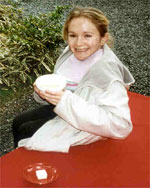
With my rucksack on my back and my hands gripping my walking frame for dear life, I narrowed my eyes, took a deep breath and charged towards the sign for the Shinkansen. The place? Tokyo station. Surrounding me and my friend Rich was seemingly every inhabitant of the city, all of whom zipped along purposefully, as if they were in training for the world power walking championships. I felt like a lowly worker ant in a hive - even taking the tube in London's rush hour hadn't prepared me for this. At least in London I could read the maps. In Tokyo station and on the underground and surface lines most station names have an English translation, but some maps omit it. Rich and I had become adept at trying to recognise Japanese characters using our imaginations (temple with a line through it followed by wardrobe), and if that failed we'd whip out the phrase book and hope that a kindly, English-speaking citizen would take pity on us, which they often did.
Earlier that day, during our rush to catch our train, we took the underground and then changed for an overground line to Tokyo station, but didn't have a clue which platform to take. A passerby not only helped us out in English, but also took us to the platform himself and carried some of our bags. His kindness and friendliness was typical of the hospitality we came across in Japan. In London, if someone offered to carry your bags you'd assume it would be the last time you'd ever see them. Not the case in Japan, however, and thanks to the man's help we made it to Tokyo station with ten minutes to spare, enough time to find our platform for the Shinkansen - the bullet train.
Like most major stations around the world, Tokyo operates on a 'survival of the fittest' philosophy. Thoroughly forlorn travellers look like they would throw you down the escalator if it meant they'd get to their destination 30 seconds sooner. If there were lifts we didn't find them, so we charged for the escalators. I stood on the right, as is the custom in London, until I noticed three laptop carrying businessmen in a rush behind me. Looking up, everyone else was standing on the left, so I did as the Japanese do and the lucky businessmen got to their destination half a minute quicker. We made it to our train to Hiroshima on time, walked past an airbrushed poster of a grinning Ewan McGregor advertising something Japanese, and sunk down into our seats with great relief.
Earlier that day, during our rush to catch our train, we took the underground and then changed for an overground line to Tokyo station, but didn't have a clue which platform to take. A passerby not only helped us out in English, but also took us to the platform himself and carried some of our bags. His kindness and friendliness was typical of the hospitality we came across in Japan. In London, if someone offered to carry your bags you'd assume it would be the last time you'd ever see them. Not the case in Japan, however, and thanks to the man's help we made it to Tokyo station with ten minutes to spare, enough time to find our platform for the Shinkansen - the bullet train.
Like most major stations around the world, Tokyo operates on a 'survival of the fittest' philosophy. Thoroughly forlorn travellers look like they would throw you down the escalator if it meant they'd get to their destination 30 seconds sooner. If there were lifts we didn't find them, so we charged for the escalators. I stood on the right, as is the custom in London, until I noticed three laptop carrying businessmen in a rush behind me. Looking up, everyone else was standing on the left, so I did as the Japanese do and the lucky businessmen got to their destination half a minute quicker. We made it to our train to Hiroshima on time, walked past an airbrushed poster of a grinning Ewan McGregor advertising something Japanese, and sunk down into our seats with great relief.
This is the age of the train
As someone who avoids British train travel like the plague, I was enraptured by the Japanese rail service. Not only are the trains fast, efficient, clean and numerous, but they're actually on time too! Stations and platforms have tactile flooring showing visually impaired travellers where the carriage doors will be; monitors tell passengers when trains will arrive, nearly all the trains I went on were level with the platform without a gap, and Braille was common on station signs, maps and in lifts. The bullet trains themselves have wide aisles; handy for my walking frame and wide enough for the train staff to twirl the seats round so passengers are always facing the right way. Best of all is the average speed of just under 200 kilometres per hour, and the view out of the window when the train tilts going round a bend.
Our Japanese rail passes enabled us to afford to travel around the country by train. Tourists can only buy a voucher outside of the country and then exchange it for the pass once in Japan. Rail passes are valid for 7, 14 or 21 days, depending on how much you want to fork out, and are financially worth your while if you plan to 'bite the bullet' more than a couple of times.
Our Japanese rail passes enabled us to afford to travel around the country by train. Tourists can only buy a voucher outside of the country and then exchange it for the pass once in Japan. Rail passes are valid for 7, 14 or 21 days, depending on how much you want to fork out, and are financially worth your while if you plan to 'bite the bullet' more than a couple of times.
Western influences
Japan is a relatively expensive country to visit, though buying lunch from supermarkets or wandering down back streets to find eating-places aimed at locals rather than tourists keeps the costs down. Restaurants display plastic versions of their meals in the window - not particularly appetising if you're opting for something covered in what looks like congealed gravy - but great for using the universal language of gesticulation to get what you want. Otherwise, huge vending machines grace most street corners - feed them yen to get flowers, cigarettes, underwear, self-titled 'gourmet' meals that heat up in seven minutes by chemical reaction when a string is pulled, or rather more mundane beer and soft drinks. In a thirst I tried Pocari Sweat. Fortunately, it doesn't taste like sweat at all - more like watery milk of magnesia. Next time I opted for a can of a more familiar soft drink.
As with brand names, western influences are everywhere in this highly commercialised and industrialised country - especially when we spent hours searching numerous department stores for Japanese souvenirs, only to find English, French and American designer goods. (Head for the International Arcade in Tokyo instead to pick up as many kimonos, chopsticks, fans and pictures as you can carry). Yet if you look closer, you discover that what's familiar is also alien. Mobile phones are large with colour video screens; toilets are either Japanese style in the ground or western style, but with heated seats and squirting water; commuters wear white masks (in the style of Michael Jackson) to protect themselves from pollution; and it's not considered hygienic to cough or blow your nose on a handkerchief in public, yet it's acceptable for men to spit in the street.
As with brand names, western influences are everywhere in this highly commercialised and industrialised country - especially when we spent hours searching numerous department stores for Japanese souvenirs, only to find English, French and American designer goods. (Head for the International Arcade in Tokyo instead to pick up as many kimonos, chopsticks, fans and pictures as you can carry). Yet if you look closer, you discover that what's familiar is also alien. Mobile phones are large with colour video screens; toilets are either Japanese style in the ground or western style, but with heated seats and squirting water; commuters wear white masks (in the style of Michael Jackson) to protect themselves from pollution; and it's not considered hygienic to cough or blow your nose on a handkerchief in public, yet it's acceptable for men to spit in the street.
City of contrasts
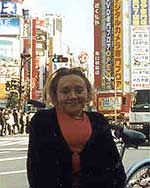
Tokyo embodies these contrasts. Huge and bold as brass, it's a whirl of sights, smells and very loud noises. Women wearing kimonos walk next to power-suited businesswomen. The commercial and shopping districts of Ginza and Shinjuku exude energy - masses of people sweep past huge billboards, neon hoardings and outdoor movie screens blaring out adverts and pop videos. Traffic fights for room on the road and pedestrians wait for the beeping pedestrian crossing to tell them it's safe to cross. One noise sounded like a birdcall and the other reminded me of a funeral dirge - considering the number of vehicles, it's a pointed reminder of the perils of jaywalking.
For some relative quiet we headed to the Imperial Palace - home to the Emperor - and its surrounding gardens. On Sundays, traffic is banned from the park and it becomes a peaceful haven for families and cyclists. Not a haven from officials, however. Walking up to the palace we had to cross a road. Seeing as it was a Sunday and there was no traffic except a mum with a pram, we started to cross ... only to be whistled at by a zealous official. We had to wait for the sound of the funeral dirge before we could proceed to the viewing point.
For some relative quiet we headed to the Imperial Palace - home to the Emperor - and its surrounding gardens. On Sundays, traffic is banned from the park and it becomes a peaceful haven for families and cyclists. Not a haven from officials, however. Walking up to the palace we had to cross a road. Seeing as it was a Sunday and there was no traffic except a mum with a pram, we started to cross ... only to be whistled at by a zealous official. We had to wait for the sound of the funeral dirge before we could proceed to the viewing point.
Temples and Fuji
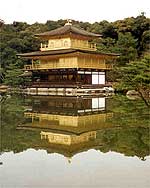
A few hours ride away on the bullet train, Kyoto is also a busy, modern, concrete city famous for its numerous shrines. Some are up many steps or steep hills, but two of the best are perfectly accessible, have Japanese gardens and even provide visitor information in English. Turning the corner after the ticket office, the beauty of Kinkaku-ju Temple shines out - providing there aren't lots of other eager tourists and school parties blocking the view. Called the Golden Temple because of the gold foil covering the exterior, the historic-looking building is actually a 1955 copy (a monk burnt down the 1397 original in 1950). Sanjusangen-do Temple, situated in the east of the city, is nearly the real thing. It is a copy - but built in 1266 from a 1249 original. We took off our shoes as a mark of respect and went inside to see more than a thousand wooden Buddhist figures standing guard.
Whilst there are many attractive shrines in Japan, for me the best sight in the country was Mount Fuji. After spending the night in a traditional Ryokan inn in Hakone (guests sleep on futons and wear dressing gown style yukatas), we took a cable car up to a viewing point. It was a clear, sunny day, so the view of the mountain with its snowy cap was unobstructed by cloud. Visitors can climb the mountain in the summer, and outside that season the cable car or a boat trip across Lake Ashino-ko make great viewing alternatives. It's cheaper to buy the Hakone free pass than pay for the trips separately. The pass, valid for two days, covers the return bus ride from Odawara train station plus the boat and cable car trips.
Whilst there are many attractive shrines in Japan, for me the best sight in the country was Mount Fuji. After spending the night in a traditional Ryokan inn in Hakone (guests sleep on futons and wear dressing gown style yukatas), we took a cable car up to a viewing point. It was a clear, sunny day, so the view of the mountain with its snowy cap was unobstructed by cloud. Visitors can climb the mountain in the summer, and outside that season the cable car or a boat trip across Lake Ashino-ko make great viewing alternatives. It's cheaper to buy the Hakone free pass than pay for the trips separately. The pass, valid for two days, covers the return bus ride from Odawara train station plus the boat and cable car trips.
Last stop
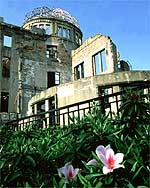
Our final port of call was Hiroshima. A modern, concrete urban sprawl, it seemed like any other city until we visited the large peace park. At the edge is the ruin of the bomb dome - a building close to the centre of the atomic bomb explosion in 1945. The park lives up to its name - it is a quiet, peaceful place with monuments to the thousands of people who died from the explosion and its subsequent radiation. A museum documents the events that lead up to the dropping of the bomb, and campaigns for the complete abolition of nuclear weapons. I left with the image of a rusty tricycle in my mind - the 'best friend' of a toddler who died hours after the blast.
Hiroshima marked the end of our trip. Time to once again put on the backpacks and head for the station. Ewan McGregor smiled down at us as we boarded our final bullet - to the airport.
Hiroshima marked the end of our trip. Time to once again put on the backpacks and head for the station. Ewan McGregor smiled down at us as we boarded our final bullet - to the airport.
The BBC is not responsible for the content of external internet sites.
More articles about
Bookmark with...
Live community panel
Our blog is the main place to go for all things Ouch! Find info, comment, articles and great disability content on the web via us.
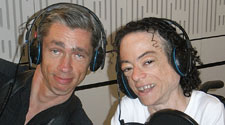
Listen to our regular razor sharp talk show online, or subscribe to it as a podcast. Spread the word: it's where disability and reality almost collide.
More from the BBC

All the latest news from the paralympics.

News and views for people who are blind or partially sighted.

Weekdays 12.40pm. Radio 4's consumer affairs programme.

~RS~q~RS~_bbc_=0&__ip__=54.77.26.26&dnainitialtitle=Bullet%20Trains%20and%20Walking%20Frames&dnahostpageurl=http://www.bbc.co.uk/ouch/features/bullet_trains_and_walking_frames_1218.shtml&dnauid=ouch:article:1218&s_baseHeadingLevel=1&dnashow=10&dnafrom=0&dnato=9&dna_encoding=utf-8&s_sssicomponent=1&s_sssiCommentCount=&dnacommentforumlistprefix=%5B_%5D&dnarecentcommentsprefix=%5B_%5D&s_commentprofileurl=/dna/mbouch/CommentProfile?&s_contact=0~RS~z~RS~49~RS~)

Comments