
Home > Features > Beijing, anyone?
Beijing, anyone?
28th April 2008
Until April 2005, I played quite a lot of sport. Football, tennis, that kind of thing. I was always competitive, but with what I liked to think of as 'Corinthian spirit'. And yet, throughout my many years of able-bodied sport, I was never asked if I was considering playing the World Cup or Wimbledon.
Then, in 2005, I fell out of a tree and broke my back. This was, I hasten to add, a pure accident, and not an attempt to improve my sporting chances.
What could possibly go wrong?
During my rehabilitation at Stoke Mandeville's Spinal Injuries Centre, I was introduced to wheelchair sport as part of my rehab programme. This was in the very gym that served as the cradle of the Paralympic movement in 1948. Soon I was playing table tennis and archery with enthusiasm.
After I was discharged, I went back to Stoke Mandeville to compete at the Inter-Spinal Games with competitors from all the spinal units. It was great fun. Competitive, but open and encouraging - a really good way of introducing people to disability sport.
There was also a healthy contingent from the various Paralympic organisations in attendance, so frequent mutterings of "Beijing, London 2012" could be overheard, as competitors were offered the mathematical possibilities. "Fifty people playing competitively, four Olympic places, two years to Beijing, six years to London."
I'm sure that encouragement towards sporting excellence has increased as the Paralympics has gained a wider public profile. But is this partly a wish in mainstream society to view every disabled person as a possible medal winner? I can understand the desire for positive role models, but is the rise and rise of the 'super cripple' a way of assuaging some kind of social discomfort surrounding disability? The old "Yeah, but you did a marathon; I couldn't do that". Now I don't hear that, mainly because I don't do marathons, but I do sometimes get "Look at the size of your arms!" Yes, but my arms aren't this way out of sheer vanity, but because I use them to haul my sorry carcass around every waking moment of my life.
I am a sports fan - not just as a spectator, watching my beloved Arsenal for far too many, often painful years, but also as a participant. And I miss team sport. Although I hated basketball when I was at school, I found wheelchair basketball to be much more enjoyable. But before I realised what I'd sign up to, I was shown a fixtures list that included matches in places as far afield as Cardiff and Exeter. I have a young family, and the prospect of all that travelling just wasn't realistic, and it seemed unfair to only play the home games when other players had put in the miles.
What could possibly go wrong?
During my rehabilitation at Stoke Mandeville's Spinal Injuries Centre, I was introduced to wheelchair sport as part of my rehab programme. This was in the very gym that served as the cradle of the Paralympic movement in 1948. Soon I was playing table tennis and archery with enthusiasm.
After I was discharged, I went back to Stoke Mandeville to compete at the Inter-Spinal Games with competitors from all the spinal units. It was great fun. Competitive, but open and encouraging - a really good way of introducing people to disability sport.
There was also a healthy contingent from the various Paralympic organisations in attendance, so frequent mutterings of "Beijing, London 2012" could be overheard, as competitors were offered the mathematical possibilities. "Fifty people playing competitively, four Olympic places, two years to Beijing, six years to London."
I'm sure that encouragement towards sporting excellence has increased as the Paralympics has gained a wider public profile. But is this partly a wish in mainstream society to view every disabled person as a possible medal winner? I can understand the desire for positive role models, but is the rise and rise of the 'super cripple' a way of assuaging some kind of social discomfort surrounding disability? The old "Yeah, but you did a marathon; I couldn't do that". Now I don't hear that, mainly because I don't do marathons, but I do sometimes get "Look at the size of your arms!" Yes, but my arms aren't this way out of sheer vanity, but because I use them to haul my sorry carcass around every waking moment of my life.
I am a sports fan - not just as a spectator, watching my beloved Arsenal for far too many, often painful years, but also as a participant. And I miss team sport. Although I hated basketball when I was at school, I found wheelchair basketball to be much more enjoyable. But before I realised what I'd sign up to, I was shown a fixtures list that included matches in places as far afield as Cardiff and Exeter. I have a young family, and the prospect of all that travelling just wasn't realistic, and it seemed unfair to only play the home games when other players had put in the miles.
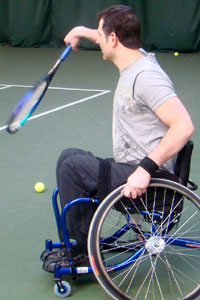
My point is this: where is the disabled equivalent of the kick-about in the park? I know there are certain complications, and that 'jumpers for goalposts' doesn't translate easily to 'shopping trolleys for wheelchairs', but why is it that whenever there is a chance to get together and play, some kind of instant 'serious competitive virus' pervades the game?
I know that as I career headlong towards forty, my sporting opportunities are different to someone younger, and I also recognise that the equipment required offers logistical challenges. But where's the fun? I suppose what I mean is, where's the crap sport? The swing and miss, bit of a giggle sport? I don't mean not trying, or not being competitive; I just mean not cursing and scowling when you get it wrong.
And then I found it. Wheelchair tennis. A sport I can play in the local park with able-bodied friends (the wheelchair player is allowed a second bounce). A sport where the wheelchair version is fully incorporated into the same governing body. A sport I used to play before my accident. And a sport where there are only about five or six thousand players around the world. Who knows? Maybe I can still compete in the 2012 Games ...
I know that as I career headlong towards forty, my sporting opportunities are different to someone younger, and I also recognise that the equipment required offers logistical challenges. But where's the fun? I suppose what I mean is, where's the crap sport? The swing and miss, bit of a giggle sport? I don't mean not trying, or not being competitive; I just mean not cursing and scowling when you get it wrong.
And then I found it. Wheelchair tennis. A sport I can play in the local park with able-bodied friends (the wheelchair player is allowed a second bounce). A sport where the wheelchair version is fully incorporated into the same governing body. A sport I used to play before my accident. And a sport where there are only about five or six thousand players around the world. Who knows? Maybe I can still compete in the 2012 Games ...
The BBC is not responsible for the content of external internet sites.
More articles about
Bookmark with...
Live community panel
Our blog is the main place to go for all things Ouch! Find info, comment, articles and great disability content on the web via us.
Listen to our regular razor sharp talk show online, or subscribe to it as a podcast. Spread the word: it's where disability and reality almost collide.
More from the BBC

All the latest news from the paralympics.

News and views for people who are blind or partially sighted.

Weekdays 12.40pm. Radio 4's consumer affairs programme.

~RS~q~RS~_bbc_=0&__ip__=54.77.26.26&dnainitialtitle=Beijing%2C%20anyone%3F&dnahostpageurl=http://www.bbc.co.uk/ouch/features/beijing_anyone.shtml&dnauid=ouch:article:1201&s_baseHeadingLevel=1&dnashow=10&dnafrom=0&dnato=9&dna_encoding=utf-8&s_sssicomponent=1&s_sssiCommentCount=&dnacommentforumlistprefix=%5B_%5D&dnarecentcommentsprefix=%5B_%5D&s_commentprofileurl=/dna/mbouch/CommentProfile?&s_contact=0~RS~z~RS~43~RS~)

Comments