
Home > Features > A Brit in Boston
A Brit in Boston
19th August 2004
Being a Brit in Boston on Patriots Day brought out the wicked side in me.

Each year, the inhabitants of the state of Massachusetts celebrate 'kicking ass' - British colonial ass to be more precise. Back in 1775, the British governor of Fortress Boston ordered his red-coated soldiers to march to local towns and seize munitions stashed by locals who were preparing for an insurgency. The locals (not the native Americans, just Brits who had been there a long time) put up a good fight and were rewarded a few years later with independence. Modern-day Americans celebrate by waving the stars and stripes from their flagpoles, dressing up to re-enact the battle, having a skive off work and, in Boston, encouraging wheelchair-users to race through the city streets (more of which later).
Faced by all this un-Britishlike patriotism it would have been tempting to wave the flag of St George (if I had one) and sing a hearty chorus of Rule Britannia. Yet that might have resulted in getting my disabled ass kicked as well. Instead, on my journey out there, I got my ass felt up.
Airport staff are never quite sure what to do when someone with mobility difficulties passes through security. Back in the days before 9/11, some would wave me to bypass the metal detectors with a cheery grin and a preconception that someone so little and cute couldn't be smuggling drugs or weapons in the tubes of her walking frame. Now, however, they seem to be of the opinion that I would be the perfect disguise for illegal activity - that 'ickle old me could actually be a mad, bad international narcotics trafficker. Despite the fact that the hardest drug I ever touch is a packet of Nurofen, the female security personnel whipped my walking frame off me to put it through the scanner (would they have done that to a guide dog, I wonder?) and subjected me to a thorough feel-up - euphemistically called a search - by one of their staff. Then she made me balance on one leg whilst she checked my shoe soles - not very easy when the walking frame is still being scrutinised for contraband. Thank goodness I'm a yoga fan - I never thought the tree position would come in so handy. (Note to surgeons - why don't the metal rods in my legs set off the metal detectors? That would make the whole experience so much more amusing.)
Arriving into Boston, all seemed to be going well as the ground staff whisked me past the smiling photo of George W. Bush to the front of the immigration queue. Sanctioned queue-jumping is one of the few benefits of being a disabled traveller. But I hadn't reckoned on my international woman of ill-repute persona. The immigration officer, who looked like a Jennifer Lopez wannabe, glared at me as she nosed through my passport. "Mongolia? You've been to Mongolia! Why did you go there?" she barked accusingly, then snarled in disbelief as I explained I went for a holiday. "And Morocco, was that a holiday as well?" I nodded sheepishly, hoping I wouldn't have to go through this rigmarole for my Cuban, Chinese and Russian trips. There wasn't even a Florida theme-park stamp to redeem my reputation in her eyes. Fortunately at that point she got bored - probably dreaming of her future career when she wins American Idol - and let me through.
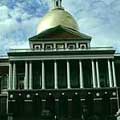
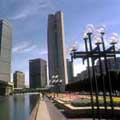
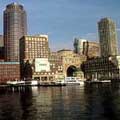
Boston, due to a history going back over two hundred years, is often described by travel journalists as being the most European city in America. It certainly has an impressive heritage - squares, historic architecture and a café-style culture of eating alfresco in the warm weather. Quincy Market has been renovated in the style of Covent Garden to house lots of scrumptious food sellers with succulent aromas. The Freedom Trail walk takes tourists past key buildings from the city's colonial past, plus the skyline of many new ones. The views from the top of the Prudential Tower are stunning. Down below are Starbucks - but hey, you get them in Europe now too.
Some banks offer talking ATMs when you plug headphones into the machine, and public facilities conform to the Americans with Disabilities Act. However, probably because a lot of the city centre was built in the days before the car, disability access is a potential headache - think cobbles, traffic jams and a very quiet noise alert telling you when it's safe to use a pedestrian crossing.
Some banks offer talking ATMs when you plug headphones into the machine, and public facilities conform to the Americans with Disabilities Act. However, probably because a lot of the city centre was built in the days before the car, disability access is a potential headache - think cobbles, traffic jams and a very quiet noise alert telling you when it's safe to use a pedestrian crossing.
The city's transport system is in a state of flux. 'The Big Dig' is in the process of rerouting some major roads underground and pulling down flyovers, but as yet is incomplete. Some subway stations are accessible to wheelchairs, some are not - including the stop for Charles MGH, the city's hospital. Work is in progress to rectify this, but I was told the story of a wheelchair-user who followed wheelchair signs in one station that was built in the 1970s. At the end of the platform he found nothing but a set of stairs - the planned lift had never been completed! His only option was to get back on the train and travel to another station.
If you can, hire a car. One of the great selling points of Boston is its proximity to the New England countryside. Spring and Autumn are the best times to travel, unless you're a skiing buff. Rockport, on the coast, is a quaint, clapboard-housing town with quirky stores and relaxing views. Further afield, the mountains of New Hampshire are stunning and easy to get to from the motorway.
If you can, hire a car. One of the great selling points of Boston is its proximity to the New England countryside. Spring and Autumn are the best times to travel, unless you're a skiing buff. Rockport, on the coast, is a quaint, clapboard-housing town with quirky stores and relaxing views. Further afield, the mountains of New Hampshire are stunning and easy to get to from the motorway.
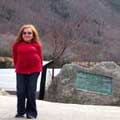
One tourist spot, with wheelchair-accessible paths, is Franconia Notch. In the nineteenth century some of the first western explorers in the region spotted a rock formation that was the spitting image of an old man's face, hence its name of the 'Old Man of the Mountain'. Sadly, however, it collapsed on May 3 2003, much to the chagrin, I expect, of the owners of the Old Man in the Mountain Gift Shop. But the area is still a popular escape for city-dwellers and running fans.
Running is a popular leisure activity in Boston, and the city's marathon is the highlight of Patriots Day. Supporters line the streets to watch the wheelchair, women's and men's races, eat fast food and enjoy the day off work. Now I've never seen the point of running over 26 miles, especially in a country where petrol is so cheap. Watching the marathon, however, started to make me feel differently, particularly when Team Hoyt passed by.
Running is a popular leisure activity in Boston, and the city's marathon is the highlight of Patriots Day. Supporters line the streets to watch the wheelchair, women's and men's races, eat fast food and enjoy the day off work. Now I've never seen the point of running over 26 miles, especially in a country where petrol is so cheap. Watching the marathon, however, started to make me feel differently, particularly when Team Hoyt passed by.
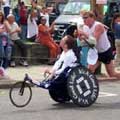
Dick and Rick Hoyt have become local celebrities due to their 20-year athletic record. Whilst his day job is developing mechanical aids controlled by eye movements, wheelchair-user Rick spends his spare time training and competing in marathons and other athletic events, with his father pushing his wheelchair. One friend of mine remarked that he had to jump out of the way when encountering the speedy duo coming down a hill during a race. In a sport increasingly dominated by money and sponsorship it was refereshing to see them - and a running duo dressed as Batman and Robin - competing just for the sheer love of it.
With the end of the marathon, Patriots Day drew to a close. I do, however, think that the only way I'll ever complete the Boston marathon is by lounging in a sedan chair eating grapes, carried aloft by four fit runners. That's if the Jennifer Lopez lookalike will ever let me back in the country and the musket-carrying patriots don't catch me first.
With the end of the marathon, Patriots Day drew to a close. I do, however, think that the only way I'll ever complete the Boston marathon is by lounging in a sedan chair eating grapes, carried aloft by four fit runners. That's if the Jennifer Lopez lookalike will ever let me back in the country and the musket-carrying patriots don't catch me first.
Bookmark with...
Live community panel
Our blog is the main place to go for all things Ouch! Find info, comment, articles and great disability content on the web via us.
Listen to our regular razor sharp talk show online, or subscribe to it as a podcast. Spread the word: it's where disability and reality almost collide.
More from the BBC

All the latest news from the paralympics.

News and views for people who are blind or partially sighted.

Weekdays 12.40pm. Radio 4's consumer affairs programme.

~RS~q~RS~_bbc_=0&__ip__=54.77.33.255&dnainitialtitle=A%20Brit%20in%20Boston&dnahostpageurl=http://www.bbc.co.uk/ouch/features/a_brit_in_boston.shtml&dnauid=ouch:article:372&s_baseHeadingLevel=1&dnashow=10&dnafrom=0&dnato=9&dna_encoding=utf-8&s_sssicomponent=1&s_sssiCommentCount=&dnacommentforumlistprefix=%5B_%5D&dnarecentcommentsprefix=%5B_%5D&s_commentprofileurl=/dna/mbouch/CommentProfile?&s_contact=0~RS~z~RS~44~RS~)

Comments