 Home Home | Explore the BBC |
 | ||
 | 19 October |  |
| ||
| | | | | | | |
| |||||||
| Search ON THIS DAY by date | | |   | |||
| |||||||
| |||||||
|
|
| | | | | | | | ||||||||||||||||||||||||||||||
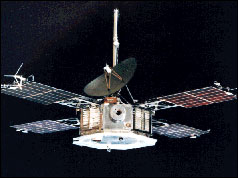
| 1967: US probe flies by hot and windy Venus The American spacecraft Mariner 5 has successfully flown past the planet Venus, just one day after a Soviet space probe disappeared into its atmosphere.
Mariner 5 passed within 2,480 miles (3,990 km) of Venus and sent back the most detailed data yet gathered about what it is like there. The probe was travelling at about 19,122 miles an hour (30,774 km/h) as it began the fly-by at 1734 GMT. After three minutes, communications were broken as it went behind the planet and out of the line of sight of the Earth. It resumed transmissions 23 minutes later. Blistering heat During the fly-by, the spacecraft's instruments measured the amount of hydrogen and oxygen in the upper fringes of the planet's atmosphere. From this information, US scientists hope to work out how much carbon dioxide is there, and also double-check the data sent back from the Soviet probe, Venera 4, yesterday. That probe was the first to penetrate the dense layer of cloud which permanently shrouds Venus. It sent back information for 94 minutes after entering the atmosphere, but then suddenly disappeared. Before it went, Venera 4 had already registered a temperature of 536 degrees Fahrenheit (280 degrees Celsius) - hot enough to melt lead. It also found high-level winds whipping round the planet at six times the force of a hurricane. Venus is often called the Earth's sister planet as it is similar in size and density, but scientists have now ruled out any possibility of life there. Near-impossible feat The logistics involved in getting Mariner 5 to curve around the front of Venus with only about 2,500 miles (4,000 km) to spare was likened by scientists to an insect being able to cut across the front of a thrown ball with just half an inch (1.25cm) to spare. The tiny spacecraft was powered by four solar panels and weighed just 244.9kg (540 lbs), as opposed to the Venera 4 which tipped the scales at about a ton. It was originally a back-up for the Mariner 4 fly-by past Mars, but was refurbished for its trip past Venus instead. More and more future planetary missions are expected to use a "standard basic design", with only key components being different for each mission.
| |
| | | Stories From 19 Oct
Web Links The BBC is not responsible for the content of external internet sites | | ||||||||||||||||||||||||||||||
| | ||||||||||||||||||||||||||||||||||||
| | | | | | | |
| |||||||
| Search ON THIS DAY by date | | | | |||
| |||||||
| |||||||
 | ^^ back to top |
| Front Page | Years | Themes | Witness | |
| ©MMVIII | News Sources | Privacy & Cookies Policy |



 Venus Express
 Space
Space What the weather is like on Venus