 Home Home | Explore the BBC |
 | ||
 | 15 October |  |
| ||
| | | | | | | |
| |||||||
| Search ON THIS DAY by date | | |   | |||
| |||||||
| |||||||
|
|
| | | | | | | | ||||||||||||||||||||||||||||||||
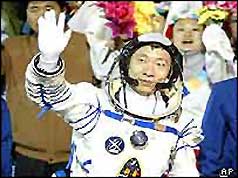
| 2003: China sends first man into space China has succeeded in sending its first manned spacecraft into orbit, making it only the third country ever to send a human into space.
A Long March 2F rocket known as the Shenzhou V blasted off from the Gobi desert launch pad at 0900 (0100 GMT), and was orbiting Earth 10 minutes later. On board was a single astronaut, Yang Liwei. He is expected to circle the planet 14 times, returning to Earth after a flight of about 22 hours. President Hu Jintao was there for the launch, and said it was "the glory of our great motherland and a mark for the initial victory of the country's first manned space flight". Elite club Only the United States and the former Soviet Union have previously sent humans into space. Yang Liwei, a 38-year-old lieutenant in the People's Liberation Army, was only publicly confirmed as the first astronaut - or yuhangyuan - just before the flight began. His first words to mission control from space were, "I feel good - see you tomorrow." He is reported to be supplied with freeze-dried shredded pork with garlic sauce and fried rice for his flight, as well as tea to drink. Closely-guarded secret Programmes on Chinese state television were interrupted to announce the successful launch. For many ordinary Chinese, it was the first they had heard of it. The space programme had been kept a closely-guarded secret until the moment of the launch itself. Soon afterwards, small crowds began gathering near giant screens outside shopping malls in Beijing as pictures showed Shenzhou streaking into the sky. The Shenzhou V is based on the Russian Soyuz three-person space capsule, although the Chinese space programme has made some fundamental changes. It is being described in the official media as "China's self-designed manned spaceship". China has been involved in space flight programmes since the 1970s, but two early efforts to put an astronaut in space were cancelled. In the 1990s, the Chinese began a collaboration with the Russians which gave a major boost to the space programme in training and equipment. Four Shenzhou spacecraft have already gone into orbit on test flights. One reportedly carried a monkey, a dog and a rabbit to test life-support systems.
| |
| | | Stories From 15 Oct
Web Links The BBC is not responsible for the content of external internet sites | | ||||||||||||||||||||||||||||||||
| | ||||||||||||||||||||||||||||||||||||||
| | | | | | | |
| |||||||
| Search ON THIS DAY by date | | | | |||
| |||||||
| |||||||
 | ^^ back to top |
| Front Page | Years | Themes | Witness | |
| ©MMVIII | News Sources | Privacy & Cookies Policy |



 China's long march into space: a history of the Beijing space race
 Space travel and discovery