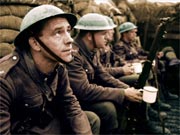
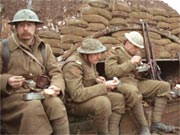
Where did your passion for World War 1 come from?
In 1984 I was the film The Old Contemptables. At Christmas my mum asked me what I wanted and I suggested something about WW1. She bought me ‘Goodbye to all that’ by Robert Graves and I was hooked. What were the difficulties with creating ‘The Trench’?
Everything had to be as authentic as possible from the uncomfortable uniforms to the conditions in the trench. An added problem was that after September 11th there was a clampdown on the movement of weapons and even deactivated ones could not be taken across the Channel so all the weaponry had to be tracked down in France. In addition, the mess tins, which are manufactured in Pakistan, had to be found elsewhere. Where did you site the trench?
It would have been too sensitive to have used the Somme itself so we found an almost perfect location at Flesquiere, near Cambrai. It was a field that had been crossed by the German Support Line. When we dug out the original trench we found countless helmets, water bottles, shells, bullets and other pieces of paraphernalia left behind by the soldiers who had used it. Fortunately we found no human remains. How was the trench itself dug?
The volunteer soldiers didn’t have to do that themselves; a mechanical digger was used for 28 days to create the trench. Fortunately the Army had kept manuals on how to dig trenches and there are also lots of photos in the Imperial War Museum so we knew just how it should look. What has happened to the trench?
The locals were so impressed that they bought the field from the owner and want to keep the trench for tourists and enthusiasts to see. It will take some upkeep as the duckboards and supports will need replacing frequently and the sandbags will rot quite quickly. How did the volunteers react to the situation?
At first they found it hard to accept that they were to live and breathe the wartime situation without a break for 2 weeks. One volunteer, when he tried the uniform asked how long he had to wear it as it was so itchy and uncomfortable. When told he had to wear it for the duration he dropped out - he had lasted just 10 minutes! What effect did the experience have on the chosen volunteers?
Quite surprising. Many of their wives commented on how they were quite distant at first on their return. They found the modern amenities and comforts quite difficult to adjust to after the deprivations and freezing conditions of the winter trench, just as their forebears had done.
They also began to appreciate just how much hard work they had to do to keep the trench viable. Most work was done at night because it was too cold to sleep.
The experience affected the group so much that they made a cross to place as a memorial in Oppy Wood where a huge number of casualties fell in 1917. How real was the experience to the men?
We followed the history of the battalion at that period of the war so a number of men were lost during the two weeks. The last volunteer to be ‘removed’ during the fortnight said how he had been convinced his character would make it through to the end. Many of the volunteers have now started to research the stories of the men they represented. What surprised you most when the programme was made?
The boredom and the trench routine - an officer could look out and know exactly what time of day it was by what the men were doing such was the specific routine. It was labour intensive all the time and everything had to be accounted for. When you think in WW1 there were two million British men in France, the equivalent of the populations of Birmingham and Glasgow, all having to be supplied with food, uniforms, munitions etc the undertaking was enormous. What are your future plans?
I’m planning a Home Front project and also looking into doing something about the Young Soldiers of 14 to 15 years who went to fight.
 |