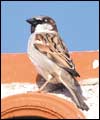
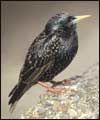
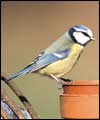
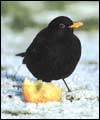
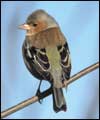
|  | Who's coming to dinner? If you don't know a sparrow from a stork, find out who's visiting your garden with this top ten of regular garden visitors from the RSPB. Each small image links to a popup page with a larger image and a sample of birdsong. . 1.House sparrow A small, thick beaked bird. Males are red-brown above, pale grey beneath, with a grey cap and black bib. The female and young are paler and sandy brown. buffy grey underneath and with a pale stripe behind the eye. 2. Starling Smaller than blackbirds, starlings are 21cm long. In the summer, starlings are black with an iridescent purple and green sheen and a yellow bill. In the winter, their white speckles become more prominent. The young are mousey brown with a pale chest, and lack the spotted breast of the adults. 3. Blue tit Little bundles of nervous energy, their blue and yellow colouring makes blue tits easily recognisable from other birds of a similar size. The vivid blue cap of the adult bird readily distinguishes it from the larger black-crowned great tit while young birds have a greenish-brown cap. Blue tits are about 11 cm long, and bright yellow underneath. Their wings are as pale blue as their tail. A black eye-stripe is matched by a black bib. 4. Blackbird The adult male has black plumage and a bright yellow bill and eye-ring. Young males have dark bills and eye-ring and their plumage still has traces of brown. The female is brown, with light brown streaks and spots on its breast. Juveniles are similar to females, but a rich brown and spotty all over. 5. Chaffinch The chaffinch is the UK's second commonest breeding bird, and is the most colourful of any of our finches. Its patterned plumage helps it to blend in when feeding on the ground and it becomes most obvious when it flies, revealing a flash of white on the wings and white outer tail feathers. Although the male's plumage consists of pinks, chestnut, white and blue, these colours are subtle. |



 Just like people, birds need water all year round for drinking and bathing.