 | 13 November 2014 |

| |
| BBC Homepage | | |
| |||
| Contact Us | | |
Nature featuresYou are in: North Yorkshire > Nature > Nature features > Bats in the cellarium 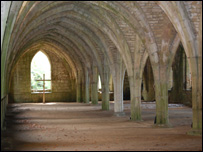 The cellarium at Fountains Abbey Bats in the cellariumBy Sarah Kay, Fountains Abbey Have you ever wondered what it would be like to make your home in an old abbey, hunt for food close by and raise your family there too? Fountains Abbey is home to quite a number of families just like that... Our very special residents live communally in the vaulted ceiling of the cellarium, as well as in over 70% of the estate’s buildings, and you may have already met the residents of Fountains Abbey if you visited on a floodlit evening – they are, of course, our bats. There are eight species of bats living on the Fountains estate, and we are fortunate to have so many because of the unimproved grassland, mixed woodland and the water features, all of which support a good population of insects on which bats feed. The pipistrelle, our smallest bat, can eat 1,000 midges a night! 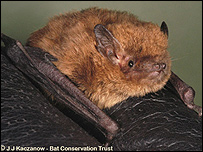 A soprano pipistrelle bat Sadly, it is the intensification of the land use, and the loss of potential roost sites (mainly in roof-spaces), which has led to a decline in the number of bats nationally. Some people are still surprised to hear that bats are very different from mice. Bats do not chew through cables, nor do they build nests. In many cases, they only occupy a particular roost site for only part of the year. For example, from spring to autumn, the abbey houses a nursery roost of daubenton’s bats who go there to give birth and raise their young. In the winter we believe that some bats stay to hibernate in the abbey. Others move to a variety of tunnels or caves to hibernate when the cold weather and lack of flying insects makes it impossible for them to remain active. When you visit the mill, have a look for a small pile of moth wings immediately below the roof ridge board – you will be looking at the remains of a long-eared bat’s dinner. It is unlikely that you would spot a bat actually up on the ridge board during the day, as they mainly feed at night, but it might be worth a quick look as you walk around. 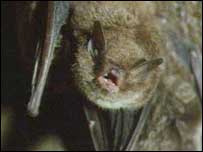 A daubenton's bat However, on a mild day in winter, when some small insects are on the wing, you could well see a single bat out flying. It is possible for bats to come out of hibernation to exploit a short period of mild weather to 'top up' on their food. I remember seeing a large noctule bat flying over the reservoir one winter day, and it took a while for me to realise it was a bat. Usually, you don’t see the colour of the bat when it flies at night, but this time I could clearly see its gingery-brown furry body. Sometimes, you can hear a bat before you see it. We use a bat detector which transforms the bats’ ultrasonic calls into a sound that we can hear easily. Using this we can tell whether a bat is just flying, or whether it is getting ready to catch an insect – known as a 'feeding buzz'. Many children and young adults can also hear the high-pitched chatter of some bats before they emerge from their roost. Two tree roosts have been discovered here at Fountains by people walking close to the tree after dark and hearing the pre-emergence chatter. 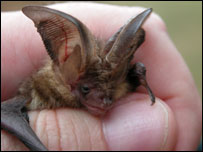 Brown long eared bat We are grateful to the North Yorkshire Bat Group who carry out regular bat counts during the summer and winter months, to check whether there are any changes to the number of bats using the estate. Sarah Kay last updated: 23/10/2008 at 17:38 You are in: North Yorkshire > Nature > Nature features > Bats in the cellarium Vampire Bat FactsBats have been been demonised in horror films over the years. Many people fear that the tiny UK mammals will try to drink their blood or get tangled in your hair! The time has come to set the record straight; Vampire bats are generally found in Mexico. They like the blood of cattle, horses, pigs and dogs. It is uncommon for them to bite humans, however it has been known for this to happen if the bat can find no alternative. The bats use their v-shaped front teeth to make an incision in the animal (or human) and then use their tongue as a straw to suck the blood out. Some bats return to the same animal night after night to feed.    [an error occurred while processing this directive] |
| | About the BBC | Help | Terms of Use | Privacy & Cookies Policy |
