| 13 November 2014 |

| |
| BBC Homepage | | |
| |||
| Contact Us | | |
Places featuresYou are in: North Yorkshire > Places > Places features > Are your plate scrapings killing the planet? 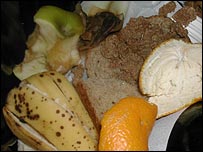 25% of what we throw away is food Are your plate scrapings killing the planet?By Nick Lawrence Next time you throw away an unopened bag of lettuce leaves, spare a thought for the teeming landfill site it will arrive at. Nick Lawrence went to meet York Rotters, to see if there's a greener way to get rid of waste food. It’s an unpleasant fact, but a quarter of what goes into our bins each week is waste food. The pasta that you couldn’t finish, the mouldy peaches in the fruit bowl, the bread that never got eaten and not forgetting the main culprit: the unopened bag of salad leaves. For most of us, that food gets thrown in the bin, taken away once a week or now more commonly, once a fortnight and we think no more of it. It ends up on the landfill site, rotting down and creating methane gas, a major contributor to greenhouse gases. So in fact, not eating that bag of ‘buy one get one free’ satsumas is actually damaging the planet…  Could you reduce your rubbish? But according to Keely Mellor of the York Rotters, it doesn’t have to be that way! She’s keen to get people thinking differently about their rubbish, and is determined to prove that less is definitely more! As Keely showed me at St. Nicholas’ Fields, the urban nature reserve in York, there are plenty of clean, convenient ways of getting rid of food waste ourselves. If you’ve already got a compost bin, the obvious way to get rid of your wasted food is by putting it in that. However, Keely warns watch out as meat, fish and processed foods are far more likely to attract rats than fruit and vegetable scraps. If your compost bin isn’t rat-proof you shouldn’t put dairy, fish, meat and processed foods in it. If you want to make your standard compost bin rat-proof, all you need to do is to dig a hole for it to sit in and put chicken netting underneath. This should keep foxes and rats at bay. If making your compost bin rat proof isn’t an option, you might want to consider a green cone. This contraption has a basket that’s buried in the ground, which is covered by a sealed unit, to prevent rats and foxes getting in. You can put all food waste, cooked, raw and processed, in it. So meat, fish and dairy products can all go in and be composted down safely without producing any methane. 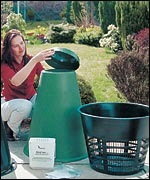 Green cone for composting processed food But if you live in a flat, or a terrace with only a yard, a more practical option might be the Bokashi. This system breaks down all food waste, making it safe to put in any type of compost bin, including those that sit on concrete. To use Bokashi, you put all raw, cooked, processed food waste plus meat, fish and dairy into a sealed bucket. Then you sprinkle them with the Bokashi, which are micro-organisms that completely stop any smell. You’d think that rotting food waste would be really unpleasant to have in your kitchen, but by adding these micro-organisms it stops the rotting process and therefore doesn’t smell. You then put that treated food waste, into a normal compost bin. So the traditional compost bin, green cone and Bokashi all result in a bin that doesn’t smell and leaves more room for other non-recyclable waste, so everyone’s a winner! (Thanks to Keely Mellor of York Rotters for providing the information for this article.) last updated: 25/02/2009 at 12:22 You are in: North Yorkshire > Places > Places features > Are your plate scrapings killing the planet? York RottersYork Rotters are a network of York residents who have been trained to give help and advice about home composting. York Rotters needs more volunteers to provide a network of local, friendly advice and support to people who already compost and those who want to start. If you would like to become a Rotter and/or would like some more information about the scheme or composting in general, please contact York Rotters on (01904) 411821, write to York Environment Centre, Rawdon Avenue, York YO10 3ST or email rotters@stnicksfields.org.uk |
| | About the BBC | Help | Terms of Use | Privacy & Cookies Policy |