From Davy Fitzsimons’ huge archive of material about the US forces around Caledon and Tynan during WWII you can quickly discover that the 23rd Infantry Regiment were housed in the upper rooms of what, until then, was the stable block below Caledon House. 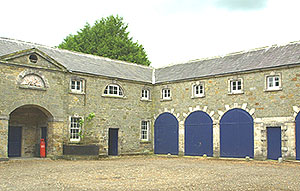
An historic regiment, it had been founded on June 26th 1812, first fighting in the War of 1812 but then remaining relatively inactive until the Civil War. It is interesting to note that as a regiment it fought in the Arizona campaign of 1866, the Idaho campaign of 1868 and the Battle of the Little Big Horn and then in 1869 it become the regiment chosen to be the first garrison for the newly acquired territory of Alaska. 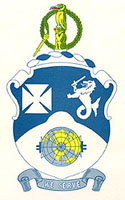 | It was from their base in Texas that they arrived in Caledon in 1942 for training by the British army in the new techniques of war that had developed during WWII.
Peacetime soldiering in the United States had not equipped them with the experience
they would need to survive against the axis soldiers.
The training was hard, much harder than they had been led to expect, but perhaps
they learned their lessons well for they went on to win battle honours in Normandy,
Northern France, The Ardennes and Rhineland. |
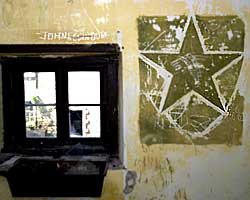
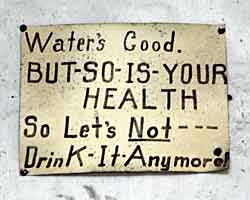
The stable block of Caledon House remains very much as it was in 1944 when the Americans left and our request to see where they had lived was received generously by the Caledon Estate and we were not disappointed. Time has taken its toll but there was enough around to see where they soldiers had lived with graffiti and formal regimental marking still adorning the walls. | | | | 60 years on.. the US 2nd Division's sign is clearly visible on a barrack room wall. | | We think the water reference is because all the laundry water tanks were open and made of lead as was the piping. |
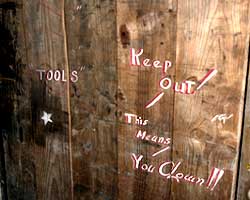
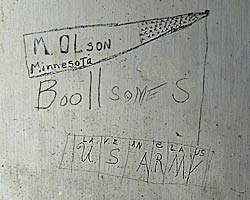
| | | | Artistic messages like this one adorn many of the walls and doors around the stable block. | | And we were left wondering what happened to M. Olsen of Minnesota... will we ever find out? |
What was fascinating was that, shortly before we arrived, the estate had been obliged to remove one in four of the floorboards of the upper rooms - that had been the barrack rooms - to treat a new infestation of woodworm. 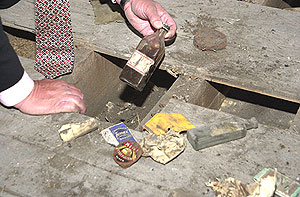
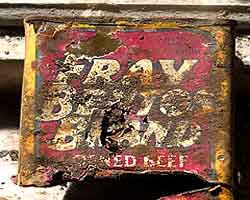
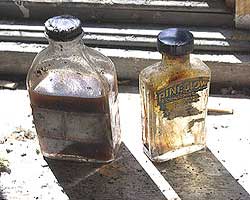
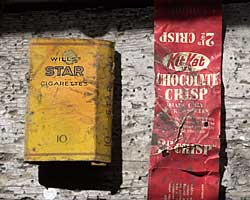
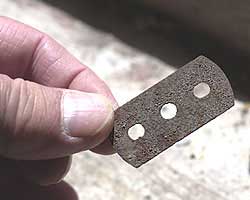
Ferretting (it seems the best word!) under the floors boards we found a host of 'treasures' from those days which are illustrated here. | | | | 'Fray Bentos', the nearest equivalent of 'Bully Beef'. Why it was under the floorboards though is anybody's guess. | | Medicine bottles with the contents still inside. The 'PineGlow' cough elixir suggests that our visitors suffered from our NI weather! |
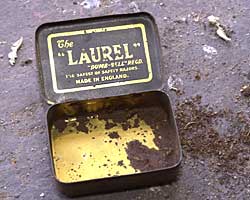
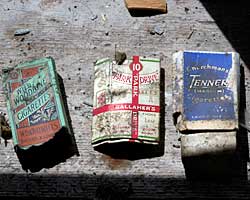
| | | | A Tobacco tin. Unlike the medicine bottles, the contents of this were long gone. | | We uncovered all manner of cigarette packets too. |
| | | | We now know that in 1943 a Kit-Kat cost two and a half D (old pennies). That's around 1p. | | Just a rusty old razor blade?..not really because they were a really hard to acquire commodity during WWII. |
Those empty rooms still seem to echo with the laughter of young men, the odd bit of graffiti leading you to wonder about the man who leaned against the wall with his pencil. It's not spooky but in the stillness of this isolated place you are left wondering about what happened to the men who lived here for that short period, what happened to them after they were prepared to go to war - how many survived? 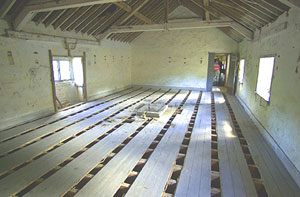
Click here to discover more of Davey Fitzsimons WWII collection. Relevant web links: GIs' visit to Co.Down after 63 years WWII Buildings in N. Ireland GI Brides leave Kilkeel in 1945 See more WWII stories here on YP&M
| 


 print version






















 POST A COMMENT ON THIS ARTICLE