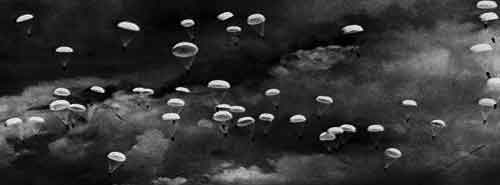
Before watching the AV documentary it might be useful to have a brief background to his own story of D-Day: Among the scores of US divisions stationed in Northern Ireland during WWII was the 82nd Airborne. USA’s first airborne division, The 82nd was stationed at: Ballyscullion, Bellaghy, Castledawson, Gortaloway, Kilrea, Rasharkin and Wilmont House in Belfast. The 82nd Airborne led the D-Day assault on Normandy and its paratroopers, along with those of the 101st Airborne, were the first allied forces to arrive in France. Parachuting in their thousands behind Utah beach in the first hour of 6th June 1944, they formed the prelude to Operation Overlord, the biggest military invasion in history. | "I'll never forget the sheer terror of that night..." |
82nd's objectives were... to drop several miles inland from the proposed amphibious beachhead, code-named Utah, alongside the Merderet river, destroy bridges over the river and clear the western portion of the beachhead area between the sea and the river. Finally, they had to establish a bridgehead on the river’s west bank. | "The scary thing was... the pilots didn't know where we were either..." |
The theory and the execution however turned out to be two very different scenarios. Bad weather meant that the pathfinders from 82nd and 101st had identified only a few of the intended drop-zones. Many of the pathfinders were themselves lost. As soon as the first planes of paratroopers crossed the coast of the Cotentin peninsula things started going badly wrong. Many of the drop-zones remained unmarked and most of those that had, couldn’t be found. Many of the pilots got lost in the thick clouds. Heavy flak coming from the enemy beneath caused the formations to scatter. Planes were being shot down everywhere and the operation incurred heavy losses.| "We jumped out into the darkness with no idea where we would land..." |
Paratroopers had to jump from their transport planes whether ready or not, often above optimum speed. The result was that troops were dispersed much more widely than planned and very few knew where they were when they landed. Some landed in the English channel. Many landed in the River Merderet or in the surrounding fields which had been flooded by the Germans. Huge numbers of men were drowned upon landing. Other unfortunate troops came down into the town of Saint Mere Eglise. Some were sucked into the flames of burning buildings. Some became entangled on wires and telegraph poles. Others, illuminated by the flames, were shot on sight.
| | For further background detail on the 82nd's landings you can read a brief chronology of the events that lead up to their D-Day- click here |
|
This is one soldier's reflections on the day and how it has been commemorated by the French. | |
|



 print version























 POST A COMMENT ON THIS ARTICLE
  You can see Mollie's AV