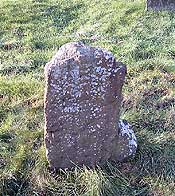
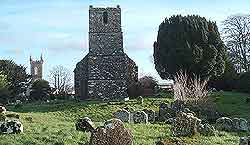
In this visit to St Lurach’s graveyard in Maghera, John Gregg spoke to William Roulston of the Ulster Historical Foundation, Fr. John Walsh, George Shiels, Mildred Moore, Sammy Hamilton & Rev. Robert Miller This site was actually home to a Cathedral before it was moved to Derry. The Cathedral was here from the middle of the 12th Century until the middle of the 13th. It’s believed that there was a church founded here in the 6th Century by Saint Lurach (or Lowry). It continued in use until 1819 when the new Church of Ireland was built just across the road. The present day ruins are actually from various periods. Some of them date back to the early Christian period and others, such as the tower, date to the 17th or 18th Century. This is therefore a very ancient and historically colourful site. Once inside this graveyard you realise just how large it is. Most of the headstones and memorials are of a simple nature and there aren’t the large Mausolea that are to be found elsewhere in the other graveyards we’ve visited (such as Drumbeg). There isn’t a large number of headstones commemorating the grand landed families or influential figures in society. This graveyard has been used by all denominations. Although it’s uncertain just when the last burial took place here, this burial place certainly hasn’t been used very much within the past 80 years. | | Stone at St.Lurach's grave |
There is a stone here which is said to be the memorial to St. Lurach himself. This is believed to be his last resting place. If it’s true then this a stone dates back to the 6th Century. George Shiels describes this headstone and notes that if you stand
well back from it you can just about see the outline of a Celtic cross. He tells us the tale of how this grave was plundered by two Englishmen in 1829. At that time, Magistrate Clark took out a deposition from various witnesses to that incident and had it recorded for posterity. |
Copy of deposition made by Alexander Hibson, regarding the opening of St. Lowry’s grave made before J.J. Clark, JP, on 29th January 1865. I Alexander Hibson, carpenter, from Maghera in the County of Londonderry, do solemnly and sincerely declare that on or about the year 1829, I was in employment of the Rev James Spencer Knox, rector of the Parish of Maghera. One morning, having occasion to pass through the old graveyard on my way from the Glebe house to the town of Maghera to buy nails, I met two persons dressed like gentlemen. One of them had a paper in his hands on which there was writing. He asked me if I was a native of the town. I said I was. He then inquired if there was a grave in the church yard in which Saint Lowry was buried, I said yes I’d often heard of it. I then went to Harry Porter the nailer, got the nails and returned through the graveyard and there found the two gentlemen filling up a hole in the grave. On the grass there was a handkerchief spread out. A blast of wind blew it up and I saw underneath it a cross. The gentlemen then left. I began to think I should tell Mr Knox. He immediately sent me to the hotel kept by Mr Falls to enquire about the men who had taken the cross. He said that they had gone some time, but whether to Moneymore or Magherafelt he could not say. Mr Knox told me afterwards that he had reason to believe that they’d gone to Dungiven and that Mr Falls had misled them. |
Mildred Moore says that there is supposed to be a tunnel that runs from the north side of the church right through the graveyard, passing close by the Saint’s grave and up into the town at the point of St. Lurach’s well. Its purpose was to connect the church with the well. Mildred tells us that there was once an interesting room found within the tunnel. When the foundations were being dug for the new Presbyterian church, a workman’s shovel fell down into a cavity. When this was investigated they found a subterranean room. In that room was discovered a wooden watering can, a book and the remnants of an old turf fire. Clearly the room has been occupied at some time. When that was no-one yet knows. Your Responses Barbara Trott - Aug '08
I have been looking for a Hibson Family in the Londonderry area.
My Great-Great Granmother was Elizabeth Hibson she was married to an Alexander McCune (McEwen) on 16 Feb 1854 the minister was Wm. Knox in Minthen, Londonderry, Ireland. When I first read this I was in hopes that maybe I had finally located the Minister or a Relative of Elizabeth Hibson McEwen. Elizabeth's mother's name was Mary Hibson, I don't have the Elizabeth's father's name. Mary Hibson was buried in New York State, USA in 1873 she had been born in 1796. If anyone has any information about Rev. William Knox or Elizabeth Hibson McCune's Family I would be very thankful for any information. The only information I have came from Alexander McCune's Civil War Pension Record. The Family name in the US is written McEwen, I don't know when the change came to be or if the McCune spelling was an error.
Edward D. Convery- February '08
Thank you for this very interesting and informative presentation. Too bad there aren't pictures of the structures. I found this in searching for my Convery family history. Apparently my family lived in Maghera in the 1700 and 1800. Some of them left for Scotland during the Great Famine and, eventually, ended up in Canada and the USA. Thanks again.
Bev Cooper -Apr '07
I was fascinated to read the article concerning the Rev Spencer Knox as i have found out that he is a relative of mine.
| 


 print version






















 POST A COMMENT ON THIS ARTICLE