| | |  | |
Bletchley Park | |
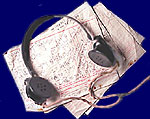
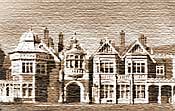
"Enigma" - you may have seen the film, but what was it really like to work at Bletchley Park, or "Station X" as it was known, during World War II ? In a 1977 BBC programme, Gilbert John heard from Betty Hutchinson about her role as a typist decoding enemy messages. (Listen - decoding enemy messages) Read more about Bletchley on the BBC's "WW2 People's War" site. |
Castlerock resident and former Bletchley employee, Gill MacDermott, reviewed the Enigma film for the "Coleraine Chronicle". She is one of a number of people in Northern Ireland who still remember being involved in the code breaking for real. We'd love to hear your memories. Gill MacDermott talked about her experiences in a remembrance programme for BBC Radio Ulster (9 Nov 2003). In "Khaki Green and Powder Puffs" women shared their stories about working on the home front and serving in the armed forces during WWII. Click here to listen to "Khaki Green and Powder Puffs".
|
|
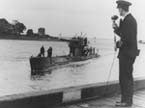
Northern Ireland played its part in other ways. The picture on the left shows Uboats entering the port of Londonderry in May 1945. A station at Gilnahirk in County Down, monitored naval communications in the North Atlantic, including Uboat messages, and passed on anything of interest to Bletchley. Can you remember it, nestled in the hills above Belfast? Do you know where it was exactly? Tell us by responding to this article... |
Your Responses: James Stewart - March '06
The photograph of the U-Boat arriving at Lisahally reminds me of my late father , a native of Londonderry who served in the Royal Navy 1941-46. "Bob" ( Stewart) was one of four brothers , two of whom did not return. James - died when his Halifax was shot down in Sept. 1943- he is buried on Ameland, and Donald who died in Japanese hands in April 1944 , a POW since the fall of Hong Kong. My father was involved in "Operation Fuller" - being on one of the MTB's sent out to intercept the Brest Squadron when they forced the channel in Feb. 1942 ( Operation Cerberus - which was to return them to German "home waters"), he also did some of the early PQ runs to Russia , and was part of the naval component of the Bruneval Raid the aim of which was to capture german radar parts and operatives. Night actions fought against E Boats in the Channel (" Off the Texel") and D-Day were taken in their stride. In may 45 he was mustered as a member of a boarding party which took several U-boats from Loch Ryan to Lisahally on the Foyle. He joined the RUC in 1946 - serbing until 1976. Severly injured by a boody trap bomb following his retirment on recovery he returned to work for the NI Police authority until retiring in 1982 , he passed away in 1998. As a child I recall visiting Lisahally with him and wondering what he saw and recalled, for him the war was a closed book on which he rarely commented. Brian Mowat The Wireless Station, as it was affectionately known by the locals of Gilnahirk was just one of a number of government listening posts scattered throughout the United Kingdom and overseas. Contat Signals Overseas Service or C.S.O.S was the official name which the station operated under. Until it closed the station operated twenty four hours a day, seven days a week, three hundred and sixty five days a year. Most of the male staff were former R.A.F. radio operators, but some ladies were employed on other duties. Surrounding the main building in the ajoining fields, were a number of steel radio masts which in turn were connected together, making up the shape of a spiders web. It is believed that a precentage of the main building is below ground and although no one ever spoke of what went on, the work was all part of what we might call, "Information Gathering." Today the building is empty and up for sale. The spiders web of radio masts has long gone, but one or two of the sma! ll cable huts which connected the masts to the main building remain. I once asked a gentleman who worked at the Wireless Station why he read so many newspapers? His answer, I like to see how long it takes for some the information we process to become public. In the years that lie ahead someone may just write a book about these places and reveal some of the secrets they once held within their walls. If you are interested to see what remains of the Gilnahirk wireless station, take a number 77 bus out of town, get off at the terminus, and go left at the crossroads of Manns Corner towards the Gransha Road. You can't miss it. Brian Willis, Bushmills You mention the "Radio Station", as it was known locally, at Gilnahirk. When we lived in Dundonald in the 60's this station was still operational and was only dismantled with the arrival of military satellites. Several Dundonald residents worked there. I knew one of them, but he would never tell me what he did. One day we were out walking with the children and dog, and passed by the station. My wife marched boldly over to the security hut and asked the guard what was the 'station' for? He didn't tell her! The site at Ballyhanwood is labelled as government offices on the OS map of the area. William Mills, Ballycastle In 1952 a detecting station was opened in Portballintrae, where the Beach Car Park now stands. It was given the grand title of "The Admiralty Marine Physical Station" and its supposed purpose was 'oceanographic research', although it now appears its actual purpose was the detection of submarines by listening to their 'sonar signatures'. Six undersea cables came ashore along a concrete ramp and entered a series of temporary huts in the compound. Until recently part of one of the cables could still be seen on the shoreline, although it is possible this section has now been washed out to sea. The station closed down in 1955 in a rather mundane way - the lease of the land ran out and Ballymoney Council wanted it back to use as a car park. The only legacy of the site is that the sewers and running piped water, installed for the station, are now plumbed into the car park public toilets. The detecting operation was transferred to its sister station in Cornwall. |



 print version























 POST A COMMENT ON THIS ARTICLE