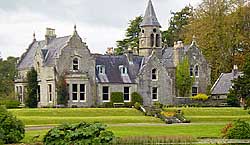
Article & pictures by Joe Simpson - Vancouver - Oct '05 Below are some photos taken last year when I visited Tempo Manor, Co. Fermanagh. This was once the "country residence" of the Belfast MP and author Sir James Emerson Tennent (1805-1869), with the present house that he completely rebuilt in the 1860s. Also included is an illustration from an old book on the Tempo Estate, of the original house once owned by the Maguires - and a very lovely winter view of the present house taken a few years ago. 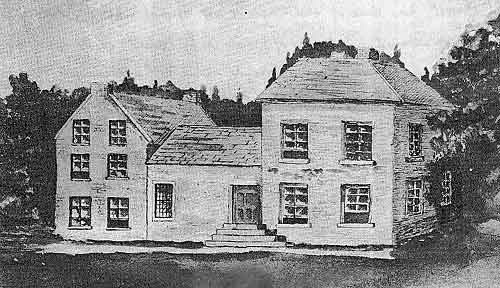
Above: The old Maguire house at Tempo, Co. Fermanagh, 1853 demolished in about 1863 and replaced by present structure. The great Charles Dickens, a friend of Sir James and his wife Letitia, stayed at Tempo Manor while visiting Ireland in the mid-1860s.
The story of the imprisonment of Lady Cathcart (in brief): Brian Maguire was succeeded by his son Cuchonnacht (pronounced “Cohonny”), who died in 1739, and he in turn was succeeded by his brother Robert. Under the penal laws passed by the Protestant Irish parliament in the early eighteenth century, a Roman Catholic landowner was forbidden to bequeath his land by will. When he died, his land had to be divided equally among all his sons. However, if the eldest son "conformed" to the Established Church, he inherited the whole estate. The Maguires of Tempo were no exception. Robert conformed, and his younger brother, Col. Hugh Maguire, did so a few years later. If half the accounts of Hugh Maguire were true, he was a desperado to out-desperado anything in fiction. After serving in the Austrian army he returned to England, and in 1745 married a Lady Cathcart. This was her fifth marriage. The "wicked colonel", as Hugh was known, was notorious in his own day, and became a legendary villain for all time, because of his treatment of his wife. Far from being satisfied with half of her considerable income, he did his worst to frighten her into handing over a fortune in jewels, and the title deeds of her English property, the Manor of Tewin Water in Hertfordshire. When she refused, he abducted her to Ireland and kept her locked up for some years at Tempo. The room where she was kept, in what later became an outbuilding, can still be seen. There must have been a good deal of talk among the neighbours about his activities, but no one dared to interfere. Duelling was common, and Maguire was a noted shot. After his death, Lady Cathcart (by then well over seventy), was released, ragged, half-starved and almost deranged, and she was able to reveal the details of how her husband had died. The story was like the climax to a gothic horror novel. Having eventually forced her to tell him that the deeds were in a secret compartment behind the panelling at Tewin, Maguire hurried there, entered the room and climbed onto the table to reach the hidden door. The rusty lock resisted all his efforts. Impatient to get what he wanted, he took out a jack knife and forced the panel. The knife slipped and cut his hand badly. Lockjaw followed, and he died in agony shortly afterwards. The great late 18th/early 19th century Irish writer Maria Edgeworth based the character of Sir Kit Rackrent, in her novel Castle Rackrent, on Col. Hugh Maguire. Lady Cathcart was said to have had inscribed in her wedding ring. "If I survive I will have had five" (i.e. 5 husbands). Article contributed by Joe Simpson Joe Simpson also sent us another article on Tempo Manor, taken from from an 1862 book that describes the rebuilding work and landscaping of the restored estate. It includes an illustration showing how the architect envisaged the house after completion the following year.
Click here to read it:
See also - 'Lady Catchcart' article on this website | 


 print version






















 POST A COMMENT ON THIS ARTICLE