|
Tim Fogg has been caving in the Marble Arch area for well over thirty years. Indeed his caving exploits, skills and enthusiasm have seen him exploring caves not just in Fermanagh but in many other parts of the world as well. And it was just these attributes that gave him and his wife Pam the idea of setting up a rope access company. In the late 80's they watched with interest the world-wide growth of this completely new service to industry. But no-one was offering the facility in Ireland, so in 1989 they formed Rope Access Specialists (www.ropeaccessspecialists.co.uk). But what is rope access? It's the scaling of buildings and other man-made structures to carry out repairs and surveys. By using the skills and equipment of the caver they were able to alleviate the necessity for companies to hire in and erect scaffolding - saving time and money. Of course the couple don't carry out this work on their own, for they are joined by other cavers such as supervisors Eoghan Lynch from Florence Court and Joe Walls from Belcoo . At times there could be a team of up to ten climbers involved on a big project. | | | 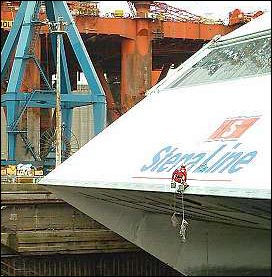 |
A diminutive worker in red overalls perches
on the nose of the HSS Ferry | |
Shipyard So what do they do? As you can imagine over the years they have faced many interesting challenges. One of their more unusual tasks is to accompany and help members of the "NI Bat Group" on their surveys of high trees and buildings. And for the past four years the team has been responsible for installing the Carrick-a-Rede rope bridge on the North Antrim coast. A task they perform the week before St Patrick's Day. The day your place and mine met them the company had just returned from painting the superstructure of the Stena HSS Ferry in dock at Harland and Wolff shipyard. |
Tourism The company is also helping the Fermanagh tourist industry. For they also run residential courses to teach others the skills and safety requirements needed. Inevitably the Ulster structural engineers, installers etc who attend the Belcoo courses always express delight at the scenery. Some confess it to be their first visit to Fermanagh, but say they plan to return to have a family holiday. Incidentally one of the groups that took part in a training course were some members of the BBC Bristol Natural History Film Unit where, at Belcoo, they were taught how to use ropes and climbing paraphernalia to safely climb trees and rock faces. | | | 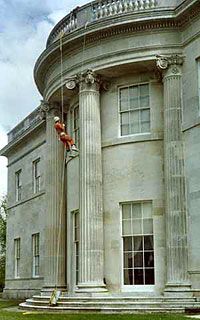 |
Carrying out a structural survey
of Castle Coole for the National Trust | |
Safety Safety, of course, is a huge consideration and all involved are tested and accredited by the various national bodies. For this is work, not a hobby and is treated in a very serious and practical manner. "It's even safer than caving" explains Tim. "For with rope access industrial standards require greater safety margins, for instance we always have a back-up rope alongside the normal harness, and all other climbing equipment is backed-up as well". Caving is for the sporting enthusiast and, yes, the skills learnt there help with rope access, but this is a big and serious company - although still grounded (pardon the pun) on skills honed deep under the limestone of Fermanagh. |
| | | 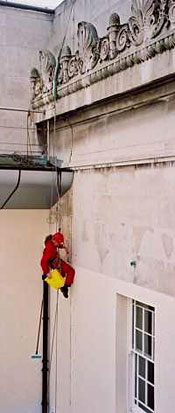 | |
Looking for a leak at Stormont | |
Caption suggestions? And the final photograph is only included to enable us to write an appropriate caption! (You might have a few ideas of your own!) It would appear that Parliament Buildings at Stormont in Belfast had plumbing troubles one year and called in the company to use a "Boroscope" to track down the leak. The climber drilled a series of tiny holes through the wall and, using a fibre-optic tube, inspected the inner cavity. Did he solve the problem? Have there been any leaks in Stormont since? To contribute your thoughts on this and anything else in this article fill in the form at the bottom of the page. Related links |
|
|
|
|
|



 print version






















 POST A COMMENT ON THIS ARTICLE