The main castle there was built in the early 1600's by Michael Balfour (a Scottish planter). At one time this included a "Bawn". The word "Bawn" is derived from two Gaelic words; "Ba", Irish for cow (or cattle) and "Dhun", meaning "fort", translating roughly into "cow-fort" or "cattle-fort". So the anglicized form of "badhun", was "Bawn".' | | | 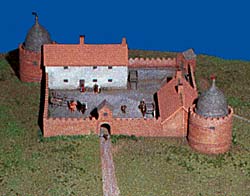 | A model showing a typical Bawn of the period.
(This one is of the famous Bawn at Bellaghy) | |
| The Bawn (as regularly constructed by the English in Ulster) was a defended courtyard with walls usually built of stone, but sometimes of brick, clay, timber and sod. They protected the house, the family, and property of the plantation's principal landlord. The house could be free-standing in the center of the bawn or, as was often the case, positioned up against one of the peripheral walls. |
The Bawn at Crom was made of lime and stone and was around 60 feet square with 15 foot high walls, the two flankers and a house. Although the Bawn successfully survived two Jacobite sieges in 1689, it was destroyed by a fire in the mid 1700's and wasn't restored. All that remains today of the castle are two gables and a flanker along with some foundations. The Crom Demesne lies four miles west of Newtownbutler. It is a National Trust Property. You can find out more about it by searching for "Crom" on the National Trust Search Page at http://www.nationaltrust.org.uk/main/placestovisit
"The Crom Story"
contributed by Vicky Herbert My first two stories are about the treasure which was buried under an oak tree at the time of the sieges of the castle in 1689, and the third story is about a local character, Tom Bailey and the workers at the walled garden on the estate. 'Cat of Nine Tales' George Ryan told me, when he was much younger, he and his brother Harry, and two friends from across the lake, Tom Bailey and Alec Greaves, wanted to dig up the treasure, but feared the 'blood curse' that the 'wee folk' had put on it. However much you doubt these things exist in the cold light of day, you always worry that there is a gleam of truth there when the time comes to actually do something! Anyway, Tom took along his black cat which, as part of the family, would have been in line to receive the curse, but as a cat has nine lives would survive the experience. None of them were cruel enough to want lasting harm to come to anything. In the event the cat won, because as they dug they kept hitting against the large stones in the ground (which are still there) and they thought that they had found the treasure chest each time. The cat was taken in and out of its basket so often in preparation for its untimely end that eventually it got extremely fed up, to say the least. As anyone who has ever tried to hold an angry cat well knows, it's an impossible task. Well, the cat escaped and ran towards the direction of the Boat House, and the lads had to give up their task. I didn't find out the end to the story until a few years ago when I was giving a tour to some local visitors, and one of them was from Derryvore. He remembered hearing that a neighbour of Tom's was passing the jetty at the Boat House in his boat and, recognising Tom's cat, wondered how it had got over the water to Crom. Since the poor thing was mewing pitifully, he picked it up and put it into his boat, so it was very soon back home at Bleanish, the island where Tom lived. In fact, it was back long before its owner. For ages he couldn't understand how the cat had transported itself back home! Maybe he thought the 'wee folk' had done it! Buried Treasure George also told me about the time he and his brother were looking at the tree, poking about and hoping to see the treasure. All of a sudden they heard a ghostly whistling and they jumped up expecting to see someone behind them. When they didn't see anyone they got really scared and ran like anything, imagining that it was the leprechauns coming to get them! But during their mad dash, they had to go over the brow of the hill in the field. In the hollow behind this they saw one of the workers returning home and he was whistling merrily away. They just hadn't been able to see him from the dip where the Treasure Tree grew and it must have sounded like a disembodied whistler! Anyway, George and his brother were too scared to return to the tree and never dared to look for the treasure again. Unexpected gift The next funny story concerns Tom Bailey and the garden staff, or rather Tom's gift to them. The standard for saleable fruit and vegetables was very high and Mr Hislop did not like to sell 'seconds' as it were. So the men used to give their neighbours some of the lopsided or odd shaped ones. At the end of this particular year, Tom went to thank the men with a wee bottle of the 'crater', that is some of his 'poteen', and they all accepted the gift in the spirit it was given! All that is except Mr Hislop, who was stricter than the others, who said that he wouldn't touch the stuff because it was illegal. So Mr Bailey said to him "Would you drink some regular whiskey if I brought it to you, Mr Hislop?" "I would surely, Tom", said Mr Hislop. Well Tom went home, got an empty whiskey bottle, filled it half-full of poteen and then to the brim with cold tea. The next morning Tom took the bottle back to Mr Hislop, who received it with thanks. No more was said, so the drink must have tasted all right! This story was told to me by Jim Graham who used to live and work on the Estate. Jim had an excellent memory and recounted many tales about Crom just after World War Two: visits by the Aga Khan, parties at the Castle and how he and his wife Ruby looked after the 'Old Rectory' or 'The Cottage' for Lady Gladstone.
These stories feature in Vicky Herbert's second book - "The Crom Story".
Did you ever buy fruit from Crom's walled garden? What do you know about the buried treasure? Have YOU any stories about Crom, or the surrounding area?
Share them by using the form at the bottom of this page. YOUR RESPONSES Yvonne - May '08
Visited this house May 08. The reason for the visit was My Mother lived in the house after the ghost left for America and was brought up there with her 10 brothers and sisters with no water, electricity or toilet. The large tree at the front of the house was where they had a swing tied to the tree and played. They never had anything strange happen to them. But when I visited and took many photos in one picture you can clearly see an orbe, very spookey.
Roseanna Donohoe - May 2004 I know a little of the background of quite a few of M/s Herbert's stories relating to Crom and more than a few of the people referred to. My father a gifted but afflicted man (too fond of a beverage) worked for some years in Crom. Many long winter nights, he and his friends discussed many of the incidents that occurred in the day to day running of Crom estate and the old tales of fact and fiction that were told and retold over the years. My own brothers picked fruit in Crom garden for several summers and we at that time lived in a house which belonged to the Estate.
Hall's bookshop in Enniskillen had copies of all M/s Herberts books about Crom and would I imagine be able to locate you a copy. Look forward to meeting M/s Herbert at some time.
"As I may be a descendent of Tom Bailey I would like to hear where a copy of the book can be purchased. If anyone has information on this name at Crom I would indeed appreciate hearing more."
( Paul Caulfield ) | 


 print version























 POST A COMMENT ON THIS ARTICLE